Gideon Welles to his son Thomas, 5 March 1865Handwritten letter
A four-page handwritten letter from the United States Secretary of the Navy to his son, in a fast nineteenth-century hand, with a postscript headed Wednesday. Transcribed page by page with unclear words marked.
Page image and transcript
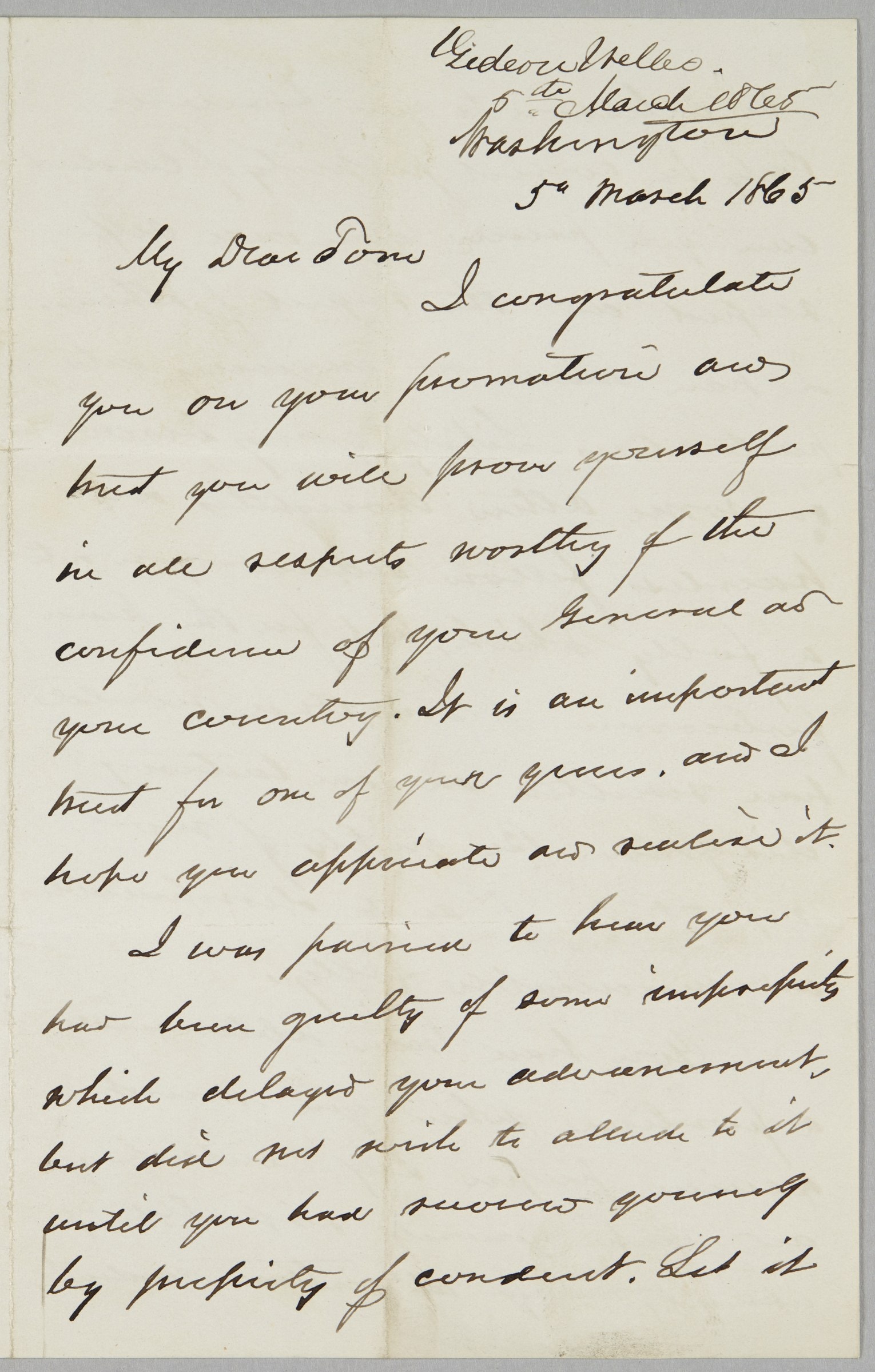
Transcript Page 1 of 4
[[note]] Gideon Welles. 5th March 1865 Washington
5th March 1865
My Dear Tom
I congratulate you on your promotion and trust you will prove yourself in all respects worthy of the confidence of your General and your country. It is an important trust for one of your years. and I hope you appreciate and realise it.
I was pained to hear you had been guilty of some impropriety which delayed your advancement, but did not wish to allude to it until you had [[recovered?]] yourself by propriety of conduct. Let it
[[word?]] marks an uncertain reading: the text inside the brackets is our best reading of a word that is hard to make out.
About this transcript
- Source
- A letter in the collection of the Smithsonian National Museum of African American History and Culture, published as two open access scans. Each scan shows two pages of the folded sheet side by side, so the scans are cropped here into four single pages in reading order.Gideon Welles, Letter from Secretary Gideon Welles to his son Thomas, March 5, 1865. Collection of the Smithsonian National Museum of African American History and Culture. Object number 2018.35.2.6.View the item at its archive(opens in a new tab)
- Rights
- Item record: "Restrictions & Rights: Public domain. Proper usage is the responsibility of the user." Images: "CC0. This media is in the public domain (free of copyright restrictions). You can copy, modify, and distribute this work without contacting the Smithsonian." Stated at https://nmaahc.si.edu/object/nmaahc_2018.35.2.6
- Convention
- Smithsonian Transcription Center general instructions
- Spelling, grammar, punctuation, capitals and word order are typed as they appear on the page, mistakes included.
- Text runs as paragraphs. Lines the writer set apart, such as dates, greetings and signatures, stay on their own lines.
- A word split by a hyphen at the end of a line is typed as one word.
- An unclear word is typed as a marked guess, [[guess?]]. A word that cannot be read is [[?]].
- Crossed-out text that can still be read is typed between [[strikethrough]] and [[/strikethrough]].
- Words added above the line are placed where they read, with no caret.
- Underlining, bold, italics and raised letters are not marked.
- Stamps, seals and pictures are named in double brackets, for example [[stamp]], followed by any text they carry.
- Notes added in the margin or by another hand are tagged [[note]].
- Tables keep their rows and columns. In plain text a table opens with a tag such as [[5 columned table]], with a vertical bar between cells and a row of hyphens under the header row.
- Page labels we add sit outside the transcript text. A page number printed on the page is typed.
- Review
- Each page was read in enlarged, overlapping strips before the Smithsonian Transcription Center volunteer transcript of the same letter was opened. One sentence of the letter had already been seen, quoted in the museum's catalogue entry. The first reading and the volunteer transcript agreed on 316 of 339 aligned words (93.2%), compared without case or punctuation. That figure measures agreement between two readings, not the accuracy of either. All 23 differences were checked against the image again: one word was changed and 22 readings were kept. A second reader then checked the whole letter against the image and one capital letter was corrected. Five words are marked as unclear.
Download the transcript
Have documents to transcribe?
Send us a sample page. We reply with the convention we would follow, the file formats and a fixed price.