Army bill of lading, Bismarck, 25 November 1876Printed form completed by hand
A printed United States Army bill of lading filled in by pen at Bismarck, Dakota Territory, for wagons and stores sent to Fort Lincoln. The face has a five-column table of nine handwritten rows and a signed receipt; the back has a filing endorsement and two certificates left empty.
Page image and transcript
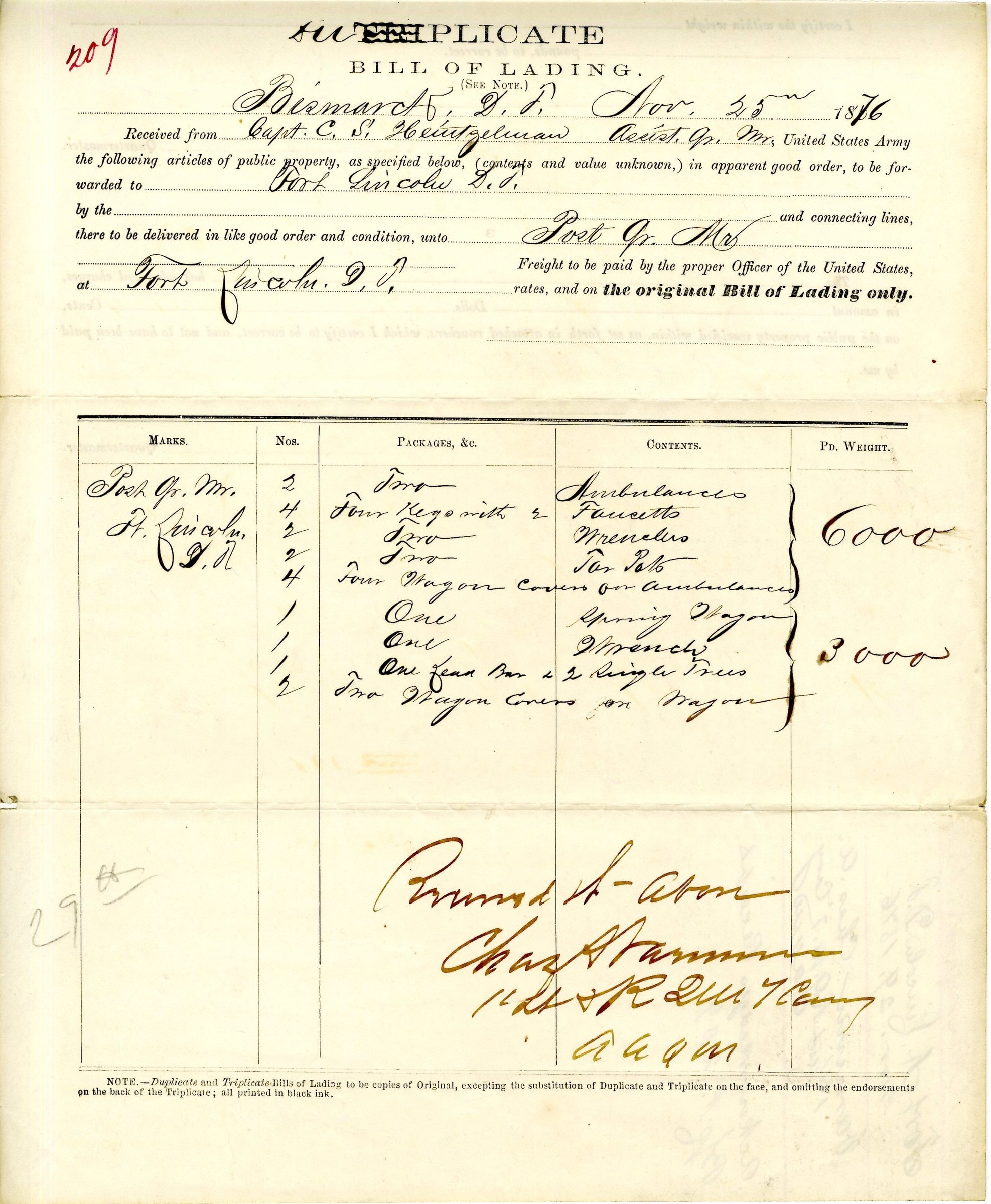
Transcript Page 1 of 2
[[note]] 209
[[strikethrough]] TRI [[/strikethrough]] duPLICATE BILL OF LADING. (See Note.)
Bismarck, D. T. Nov. 25th 1876
Received from Capt. C. S. Heintzelman Assist. Qr. Mr., United States Army the following articles of public property, as specified below, (contents and value unknown,) in apparent good order, to be forwarded to Fort Lincoln D. T. by the [[blank]] and connecting lines, there to be delivered in like good order and condition, unto Post Qr. Mr Freight to be paid by the proper Officer of the United States, at Fort Lincoln. D. T. rates, and on the original Bill of Lading only.
| Marks. | Nos. | Packages, &c. | Contents. | Pd. Weight. |
|---|---|---|---|---|
| Post Qr. Mr. | 2 | Two | Ambulances | 6000 |
| Ft. Lincoln, | 4 | Four Kegs with 2 | Faucetts | |
| D. T | 2 | Two | Wrenches | |
| 2 | Two | Tar Pots | ||
| 4 | Four Wagon Covers | for Ambulances | ||
| 1 | One | Spring Wagon | 3000 | |
| 1 | One | Wrench | ||
| 1 | One Lead Bar & | 2 Single Trees | ||
| 2 | Two Wagon Covers | for Wagon |
[[note]] 29th
Received the above Chas A Varnum 1st Lt & R Q M 7 [[Cavy?]] A A Q M
NOTE. - Duplicate and Triplicate Bills of Lading to be copies of Original, excepting the substitution of Duplicate and Triplicate on the face, and omitting the endorsements on the back of the Triplicate; all printed in black ink.
[[word?]] marks an uncertain reading: the text inside the brackets is our best reading of a word that is hard to make out.
About this transcript
- Source
- A United States Army bill of lading in the US National Archives, published in the National Archives Catalog as two scans: the face of the form and its back. Both scans are shown whole, reduced in size and not otherwise changed.War Department, Department of Dakota, Bismarck (Dakota Territory) Quartermaster Depot, Bill of Lading, 25 November 1876. Series Letters Received, Records of the Office of the Quartermaster General, Record Group 92. National Archives at Kansas City. National Archives Identifier 12088774.View the item at its archive(opens in a new tab)
- Rights
- National Archives Catalog item page: "Access: Unrestricted" and "Use: Unrestricted". Stated at https://catalog.archives.gov/id/12088774
- Convention
- Smithsonian Transcription Center general instructions
- Spelling, grammar, punctuation, capitals and word order are typed as they appear on the page, mistakes included.
- Text runs as paragraphs. Lines the writer set apart, such as dates, greetings and signatures, stay on their own lines.
- A word split by a hyphen at the end of a line is typed as one word.
- An unclear word is typed as a marked guess, [[guess?]]. A word that cannot be read is [[?]].
- Crossed-out text that can still be read is typed between [[strikethrough]] and [[/strikethrough]].
- Words added above the line are placed where they read, with no caret.
- Underlining, bold, italics and raised letters are not marked.
- Stamps, seals and pictures are named in double brackets, for example [[stamp]], followed by any text they carry.
- Notes added in the margin or by another hand are tagged [[note]].
- Tables keep their rows and columns. In plain text a table opens with a tag such as [[5 columned table]], with a vertical bar between cells and a row of hyphens under the header row.
- Page labels we add sit outside the transcript text. A page number printed on the page is typed.
- An empty blank in a printed form is typed [[blank]]. A blank that has been filled in is typed as the words written in it.
- Writing that runs across a printed column line is divided at the line. A word that crosses the line stays in the cell where it begins.
- A figure set against several rows by a brace is typed once, in the first of those rows. Here 6000 covers rows 1 to 5 and 3000 covers rows 6 to 9.
- Small capitals are typed as lower-case letters. A raised mark that stands for an ordinal ending is typed on the line, as in 25th.
- Review
- Each page was read in enlarged, overlapping strips, and every handwritten entry was then cropped again at a larger size. The National Archives Catalog holds no transcript of this item, so there is no agreement figure for this reading. A second reader then read both pages independently before seeing the transcript and checked every line against the image. Four corrections followed: one table entry was moved to the column where it is written, two punctuation marks were corrected and one capital letter became the small letter that is on the page. One word is marked as unclear.
Download the transcript
Have documents to transcribe?
Send us a sample page. We reply with the convention we would follow, the file formats and a fixed price.