Eastmere Motor SupplyA car parts store that checks every part against your vehicle

Eastmere Motor Supply is an automotive parts store for a fictional Canadian supplier. A shopper saves their vehicle once, and every listing, product page, cart line and checkout step says whether a part fits it.

An independent portfolio project, designed and built by Awan Forge. The catalogue, part numbers, prices and fitment are sample data, and the checkout takes no payment and sends no order.

Open the store

The live store with its sample catalogue. Nothing is charged.

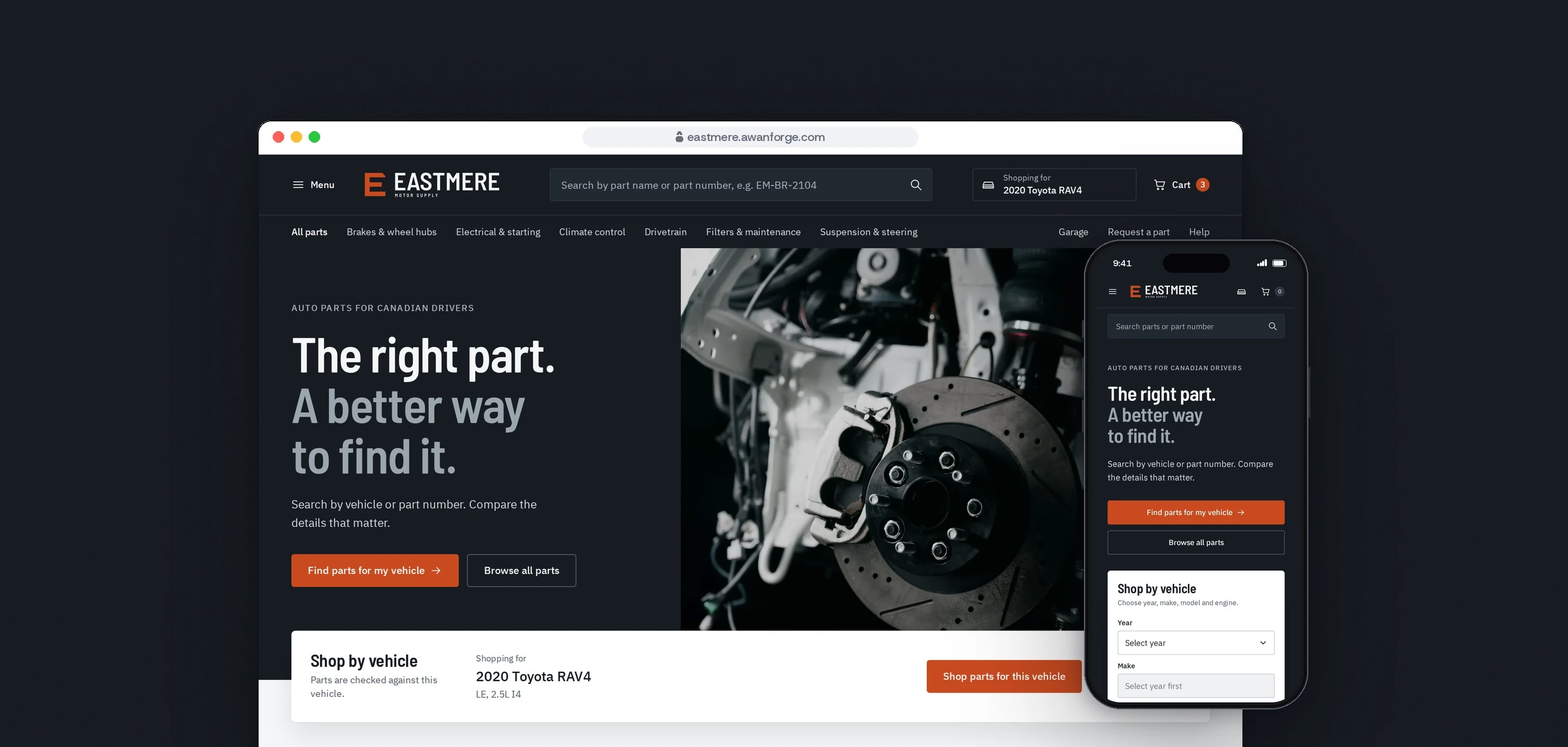
The Eastmere Motor Supply home page in a browser, headed The right part. A better way to find it., beside a brake disc photograph, with the vehicle tool shopping for a 2020 Toyota RAV4, and the same page on a phone with search on its own row.
The home page on desktop and on a phone, captured from the live store on 18 November 2026.
Type
Independent portfolio project
Platforms
Website, desktop and phone
Our work
Brand identity, design direction, product renders, storefront, testing, hosting
Built with
Next.js 16, React 19, TypeScript, Tailwind CSS 4, Radix, Motion, Three.js
Date
November 2026

A part fits the vehicle, or it is the wrong part

Eastmere sells brakes, electrical and starting parts, climate control, drivetrain, filters and suspension parts for cars and light trucks in Canada. A wrong part means a return and a second order, so the store has to answer one question wherever a part appears, in the same words: does it fit my vehicle?

It also has to say so plainly when it cannot answer.

What the store has to do

  1. Give one answer to whether a part fits, on every page.
  2. Never show a fit for a vehicle that is not fully chosen.
  3. Find a part by name or part number, inside the vehicle or across all parts.
  4. State the condition and any core charge before the cart.
  5. Say at checkout exactly what happens.

Built for

Drivers and home mechanics
They know their vehicle long before they know a part number.
People with a part number
They type it exactly and need the result even when it belongs to another vehicle.
Parts suppliers
They sell new, remanufactured and used stock, and each condition has to be explained plainly.

Everything from the name to the server

Eastmere is our own project. We named the store, drew its identity, wrote the design direction, made the product images, built and tested the storefront, and host it on our own server.

24

sample parts

6

categories

4

supported vehicles

72

original product renders

  • The name and identity: the EASTMERE wordmark with MOTOR SUPPLY beneath it, a palette of graphite, cool white and signal orange, and two open-licence typefaces.
  • A design direction written before any page: the references, a plan for each section, motion timings and copy rules.
  • A sample catalogue: 18 new parts, 4 remanufactured parts with a refundable core charge, and 2 used parts with condition notes, each with an internal part number, specifications and listed vehicles.
  • 72 product images, three views of each part, modelled in code and rendered for the store.
  • The storefront: home, shop, six category pages, product pages, a garage, a cart and cart drawer, checkout, a confirmation page, help pages and request-a-part and contact forms.
  • 28 browser tests, an accessibility check of 10 pages, a security review, and hosting on our own server with a deploy script that checks each release.

A quiet store where the controls lead

Before drawing a page we studied three live sites and wrote down what to take from each and what to change for a parts store. None of their copy, images or claims is used.

The three references, what we took from each and what we changed
ReferenceWhat we tookWhat we changed
A luxury carmaker's US websitePrimaryFew competing elements, a confident type scale, a close photographic crop and calm controls.A shorter hero, so the vehicle tool sits in the first screen, and parts search in the header.
A European parts retailerSupportingYear, make and model choices that depend on each other, a saved garage and exact part number search.The same behaviour in a quieter design, with fitment stated on every surface.
The carmaker's accessories shopSupportingA neutral product grid, a filter drawer, and a product page with compatibility near the buy button.Part number, condition, fitment and stock in place of lifestyle copy.

Colour

  • Graphite#171C22Header, footer and dark surfaces
  • Cool white#F4F6F7The page
  • Signal orange#C94A20The main action and the selected state

Type and layout

Barlow Semi Condensed SemiBold
The wordmark and the headlines.
IBM Plex Sans
Body text, controls and specifications.
1,392 px content width
With 48, 32 and 20 px gutters on desktop, tablet and phone.

Live store

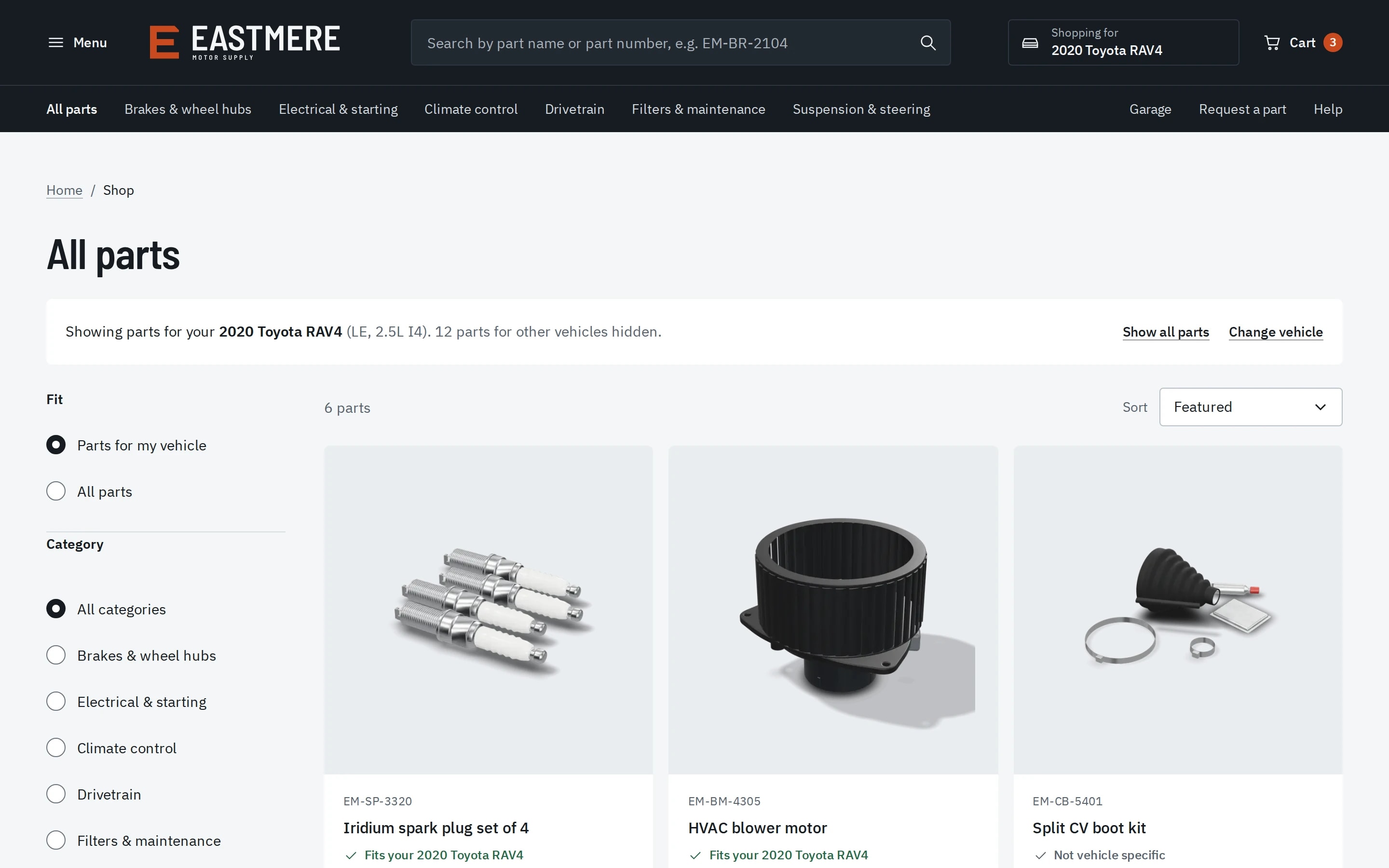
The Eastmere shop scoped to a 2020 Toyota RAV4: a bar saying 12 parts for other vehicles are hidden, Fit and Category filters, and cards for an iridium spark plug set, an HVAC blower motor and a split CV boot kit, each on the same pale grey ground with its fitment under the name.
Every product image is one of 72 renders made for this store, three views per part, modelled procedurally in Three.js and rendered headless, with no third-party models or photographs. On one neutral ground the grid reads as one catalogue. The workshop photograph and the six-second clip on the home page are Pexels stock, credited on the site.

Four decisions that carry the store

Vehicle selection, compatibility, search and the product page. Each one is a rule the whole store follows.

01Vehicle selection

The vehicle tool asks for the year, then the make, the model, and the engine and trim. Each step opens once the one before it is chosen, and only the four supported vehicles can be completed. Saved vehicles go to a garage kept in the browser, with one marked as the vehicle in use; it shows in the header on every page.

Live store
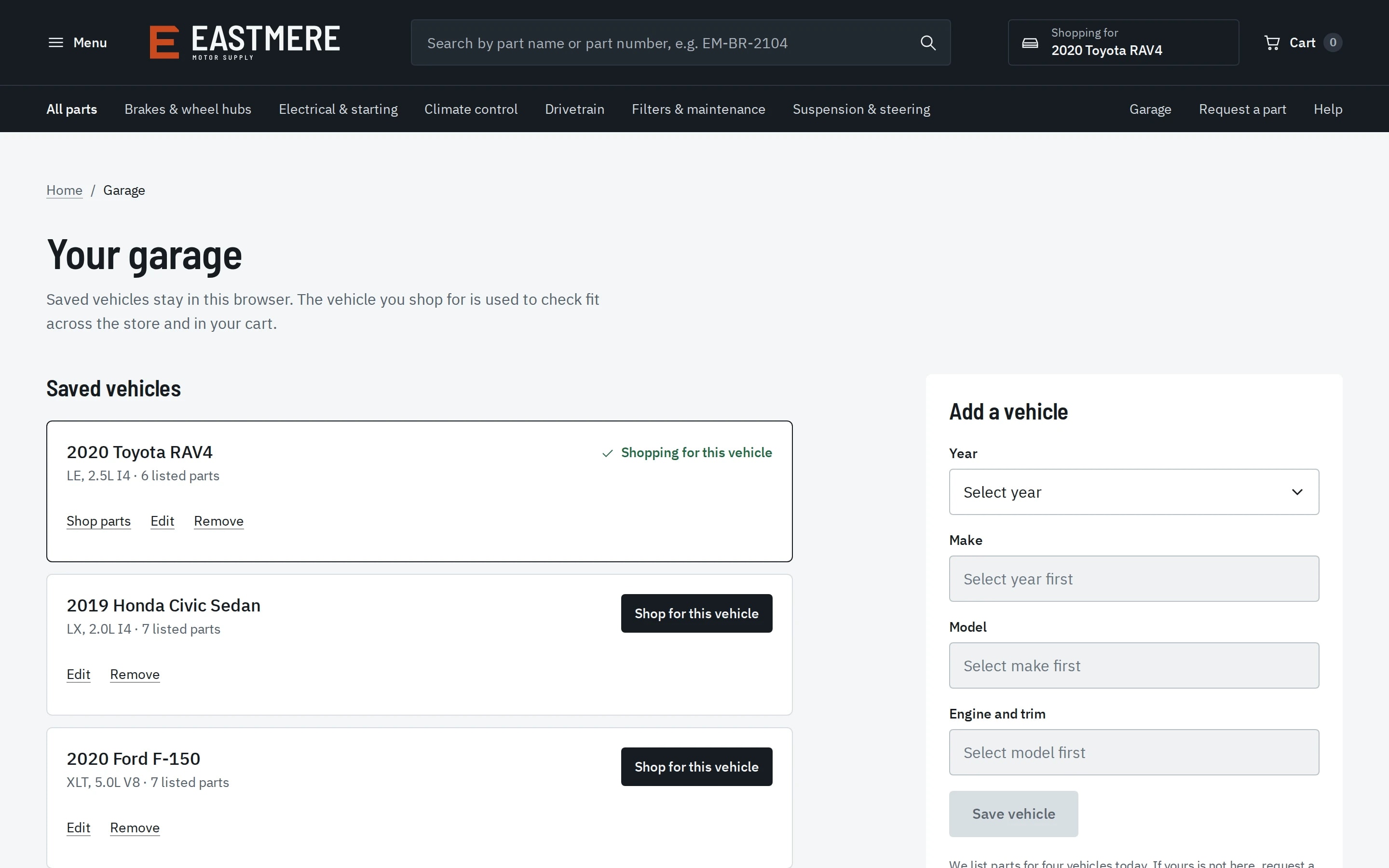
The Your garage page: three saved vehicles, the 2020 Toyota RAV4 marked Shopping for this vehicle, the 2019 Honda Civic Sedan and the 2020 Ford F-150 each with Shop for this vehicle, and an Add a vehicle form whose make, model and engine fields wait for the step before.
The garage with three saved vehicles. The RAV4 is in use and shows in the header; each card counts the parts listed for that vehicle.

02Compatibility

One function, checkFitment(), decides fitment for the listing, the product page, the cart and the checkout, so a part can never show one answer in one place and another somewhere else. It has five results, and each one has its own wording.

The five fitment results and what the shopper sees for each
ResultWhat the shopper sees
Fits“Fits your 2020 Toyota RAV4”, with the trim and engine.
Does not fitNames the vehicle it does not fit. In the cart the line offers Keep for the vehicle it was added for, or Remove.
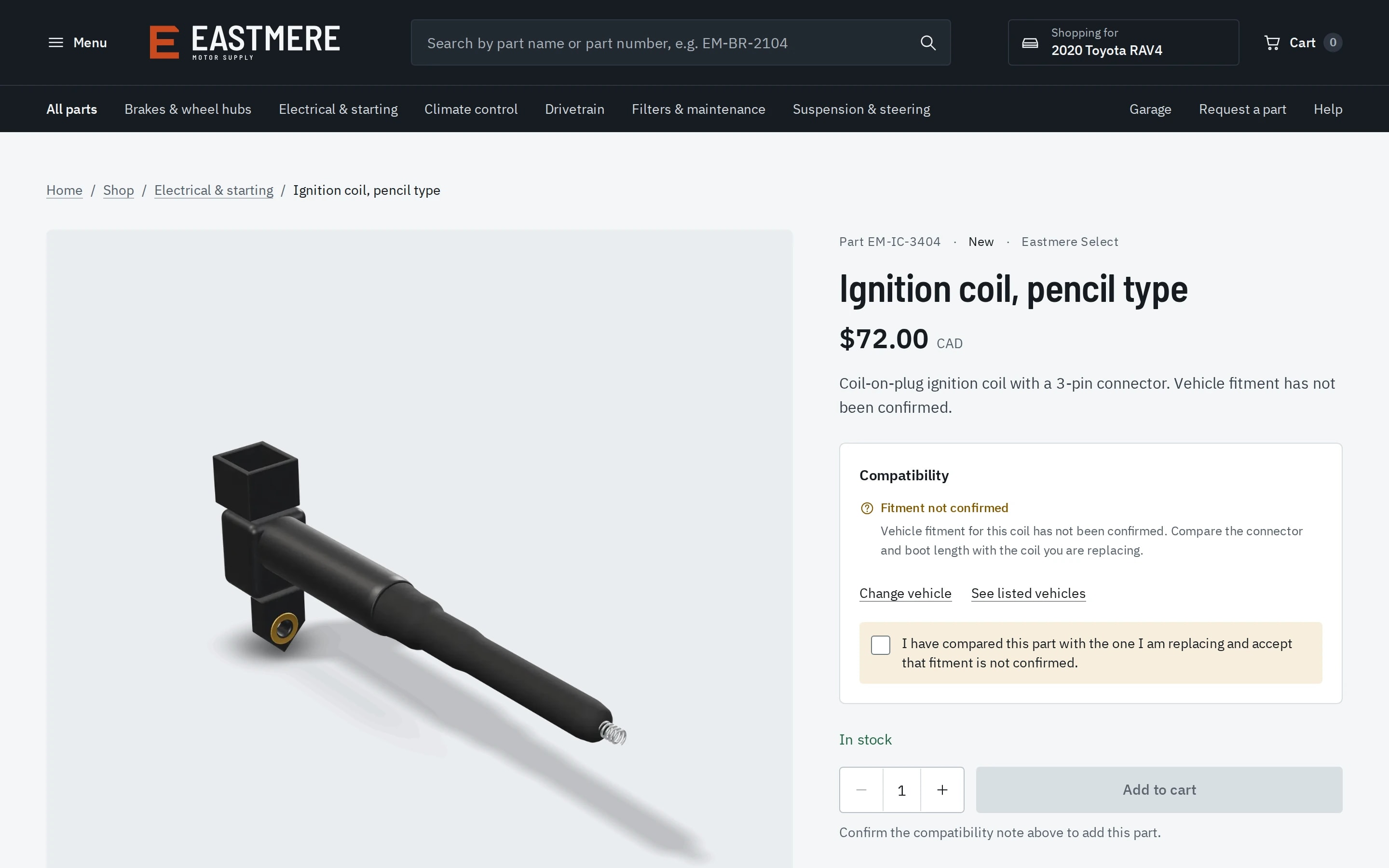
Fitment not confirmedSays what is not confirmed. Adding it to the cart needs an explicit acknowledgement.
Not vehicle specificFor universal parts, such as a split CV boot kit.
No vehicleAsks for a vehicle. A vehicle that is not fully chosen never shows a fit.

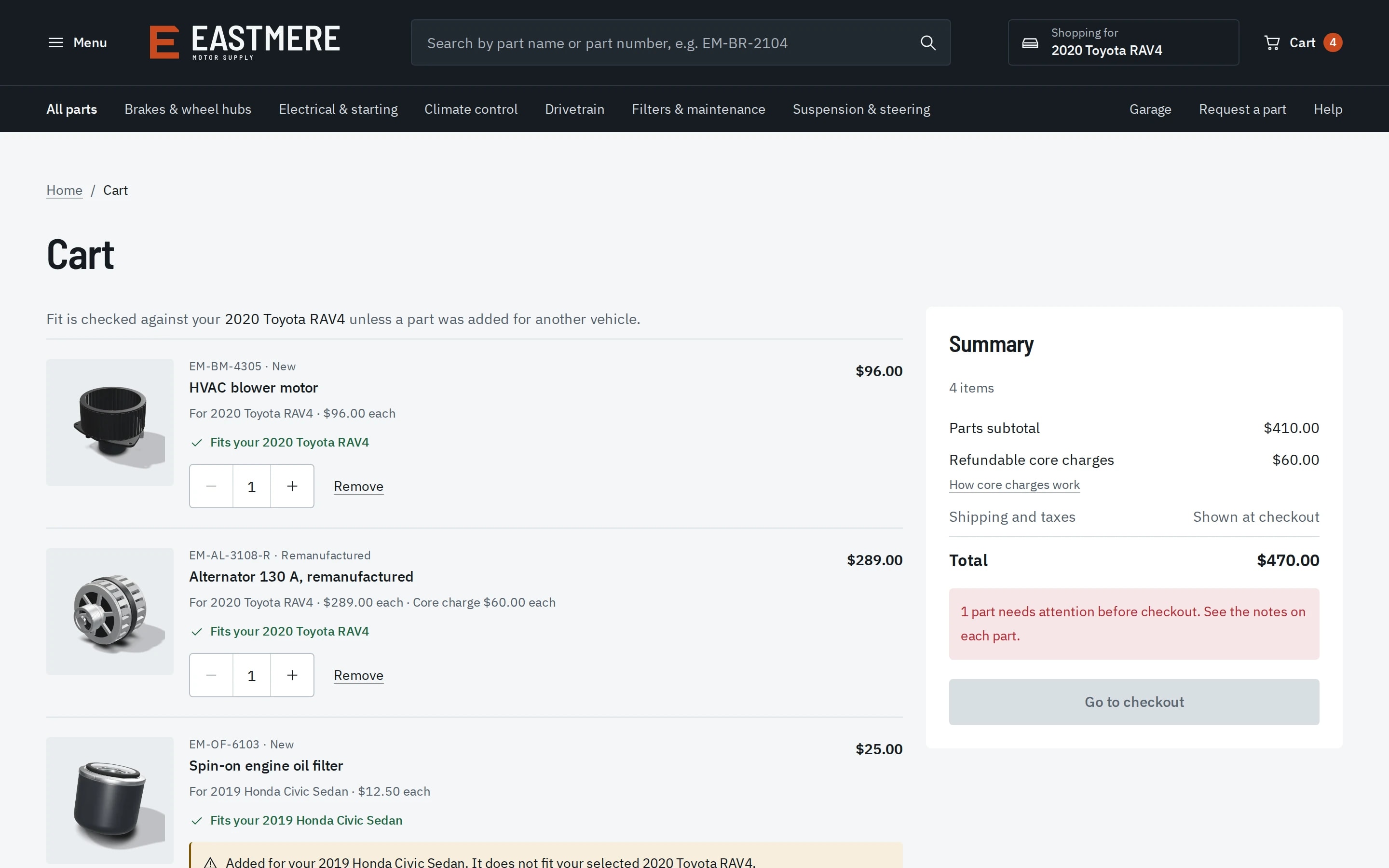
Each cart line remembers the vehicle it was added for. Switching vehicle never removes anything: a line that no longer fits shows Keep for that vehicle, or Remove, and checkout stays blocked until each one is settled.

Live store

The product page for an ignition coil, pencil type: the compatibility box reads Fitment not confirmed and asks to compare the connector and boot length, with a checkbox to accept that fitment is not confirmed and Add to cart turned off.
Fitment not confirmed. Add to cart stays off until the shopper ticks the acknowledgement.

Live store

The cart with four items checked against a 2020 Toyota RAV4, an oil filter added for a 2019 Honda Civic Sedan below, and a summary that says 1 part needs attention before checkout above a turned-off Go to checkout button.
After switching to the RAV4, a part added for the Civic stays in the cart. The summary says one part needs attention, and checkout waits.

03Search

One search box matches part names, internal part numbers with or without dashes, categories, and the other words people use for a part, such as rotor and disc. The shopper chooses the scope: the vehicle in use or all parts, and the page says how many parts for other vehicles it hid.

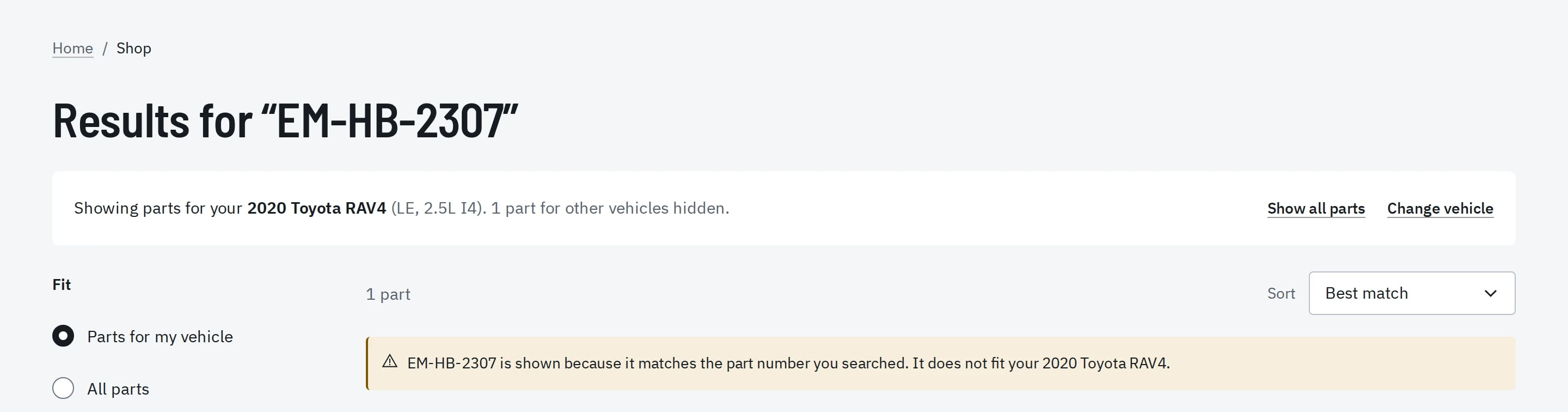
A part number typed exactly is never hidden. If it belongs to another vehicle it still appears, with a warning that it does not fit. Filters, sort, scope and page are kept in the address, so a reload or the Back button returns the same results.

Live store

Results for EM-HB-2307, scoped to a 2020 Toyota RAV4 with 1 part for other vehicles hidden, and a warning that EM-HB-2307 is shown because it matches the part number searched and does not fit the RAV4.
An exact part number for another vehicle: shown, with the reason and the warning.

04Product evaluation

The product page puts the decision in order: part number, condition and brand line, the name, the price in Canadian dollars, compatibility with the vehicle in use, stock, quantity and the action.

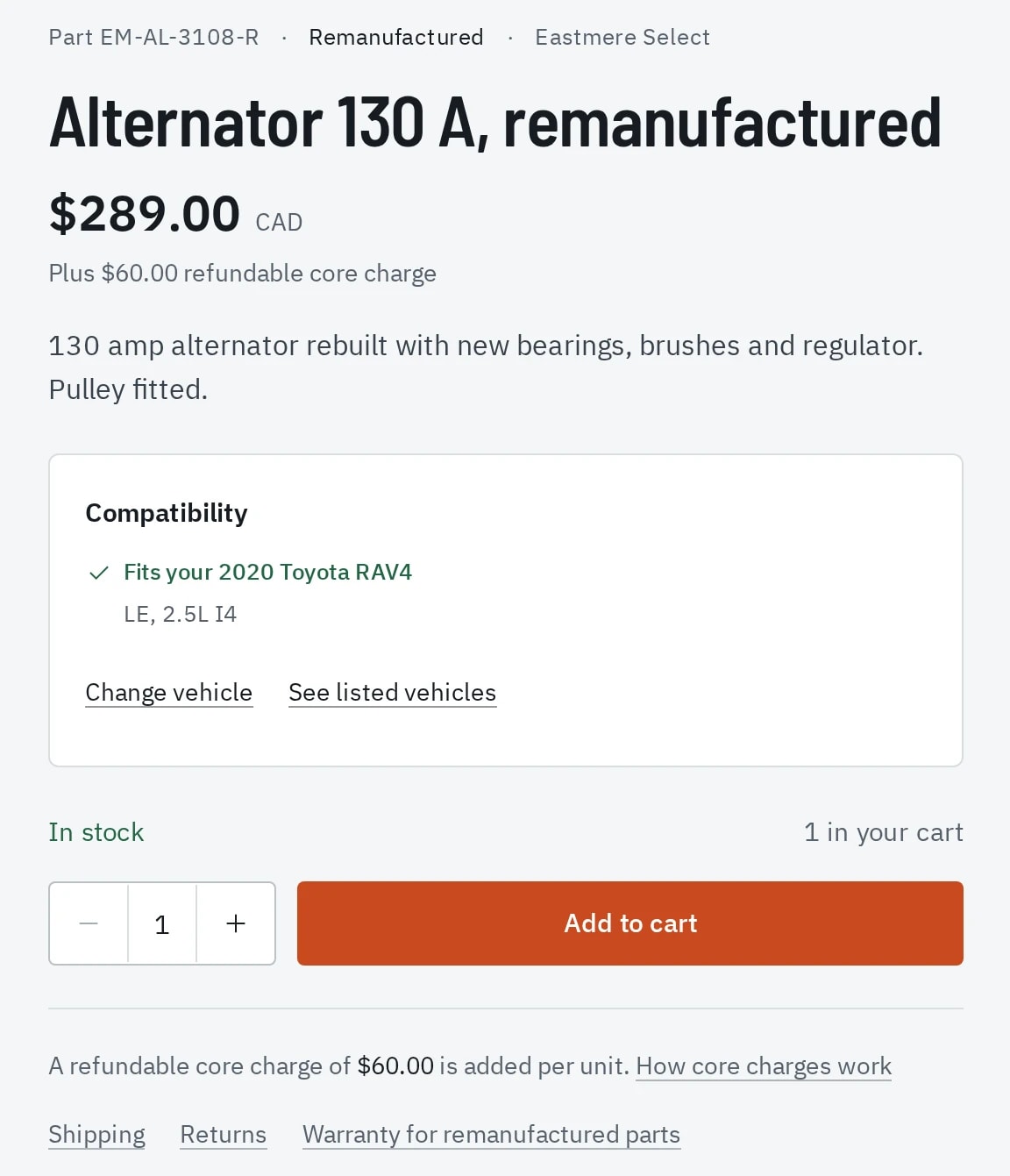
A remanufactured part shows its refundable core charge under the price, again under the button with a link to how core charges work, and as its own line in the cart and at checkout. The four remanufactured parts each carry one. The two used parts are single units with condition notes, and quantity stops at the stock.

Live store

The purchase panel of Alternator 130 A, remanufactured: part EM-AL-3108-R, $289.00 CAD plus a $60.00 refundable core charge, Fits your 2020 Toyota RAV4, In stock, a quantity stepper and Add to cart, then the core charge note and links to shipping, returns and the warranty for remanufactured parts.
The purchase panel of a remanufactured alternator, read from top to bottom.

Desktop and phone, each laid out for itself

On desktop the content runs to 1,392 px, with a filter rail beside the results and the purchase panel beside the product image. On a phone, search moves to its own row under a compact header, the vehicle tool follows the headline, filters open in a drawer with Clear and a count of the parts they will show, and each cart line stacks with its warning. Controls are 48 px high on both.

Every screen below is a capture of the live store taken on 18 November 2026.

Motion, access and speed, as measured

What was built and checked on 18 November 2026, and what the checks found.

Motion

  • Motion for React is the only animation library. Drawers open on a spring with no bounce.
  • The visitor's reduced motion setting is honoured.
  • The workshop clip loads only after the page has loaded, when it is in view, on screens 768 px and wider, and only with reduced motion and data saving off. It pauses off screen, has a pause button and falls back to its poster if it fails.

Accessibility

  • Dialogs and drawers are built on Radix primitives: focus moves in, stays there, and returns when they close.
  • The Android back gesture closes an open drawer (CloseWatcher).
  • Status changes are announced to screen readers through live regions.
  • Controls are 48 px high.
  • axe, run with the WCAG 2.0, 2.1 and 2.2 A and AA rules, reports zero violations on 10 pages.

Testing and security

  • 28 Playwright tests, on desktop at 1440 px and a Pixel 7 phone profile, cover the journey from vehicle to category, filters, product, cart, checkout and confirmation, plus reload and Back, a double add, stock limits, a vehicle change with parts in the cart, unconfirmed and incompatible fitment, out of stock parts, damaged saved data, empty states, the keyboard and reduced motion. All 28 pass locally and against the live store.
  • An independent security review found no high-severity issues; the one low-severity issue was fixed. The server sends HSTS, nosniff, a referrer policy, a permissions policy and frame-ancestors none.
Lighthouse 12, lab scores. Run on 18 November 2026 from our machine against the live store; mobile with simulated slow 4G and CPU throttling.
PagePerformance, mobilePerformance, desktopAccessibility
Home98100100
Shop90100100
Product page92100100
Cart100100100

On mobile the home page reached its largest contentful paint in 1.7 s with a layout shift of 0.006. On the shop and the product page it took about 3.1 to 3.3 s under that throttling, above the 2.5 s target. Accessibility scored 100 on all four pages after one fix. These are lab results, not data from visitors.

The finished store

Eastmere is live at eastmere.awanforge.com. Checkout is for guests and asks for no card details. Its last action says no payment will be taken and no order will be sent, and the confirmation, saved in the browser, says the same.

The request-a-part and contact forms also save in the browser, offer a text file to download, and say that nothing is sent. The store is kept out of search engines because its catalogue is sample data.

Live store

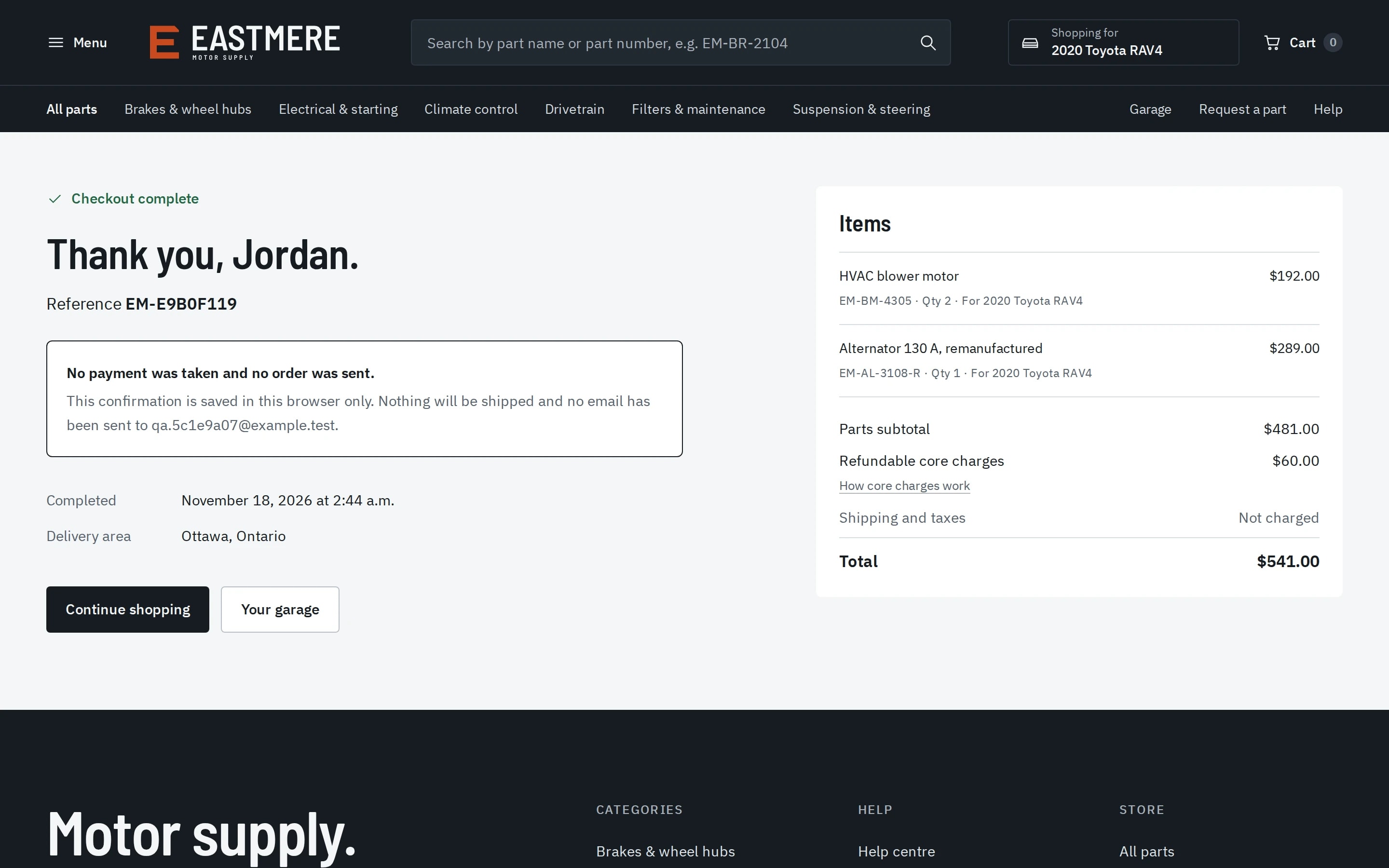
The confirmation page: Checkout complete, Thank you, Jordan., reference EM-E9B0F119, a box saying No payment was taken and no order was sent and that the confirmation is saved in this browser only, and the items with a total of $541.00.
The confirmation after a test checkout with a sample name and an example.test address.

Eastmere Motor Supply is an independent portfolio project, not a trading business. The catalogue, internal part numbers, prices, stock and every vehicle fitment relationship are sample data written for the store, not manufacturer part numbers or verified fitment. The product images are original renders; the workshop photograph and video are Pexels stock by Erik Mclean and Artem Podrez, credited on the site.

Selling parts or a technical catalogue?

We design stores where the product data helps people choose: fitment, condition, specifications and search that agree on every page. Tell us what you sell and how your customers look for it.

Open the store

Sample catalogue, stored in your browser. No payment, no order.