DifabilityRoutes into work, self-employment and business, with a side for employers
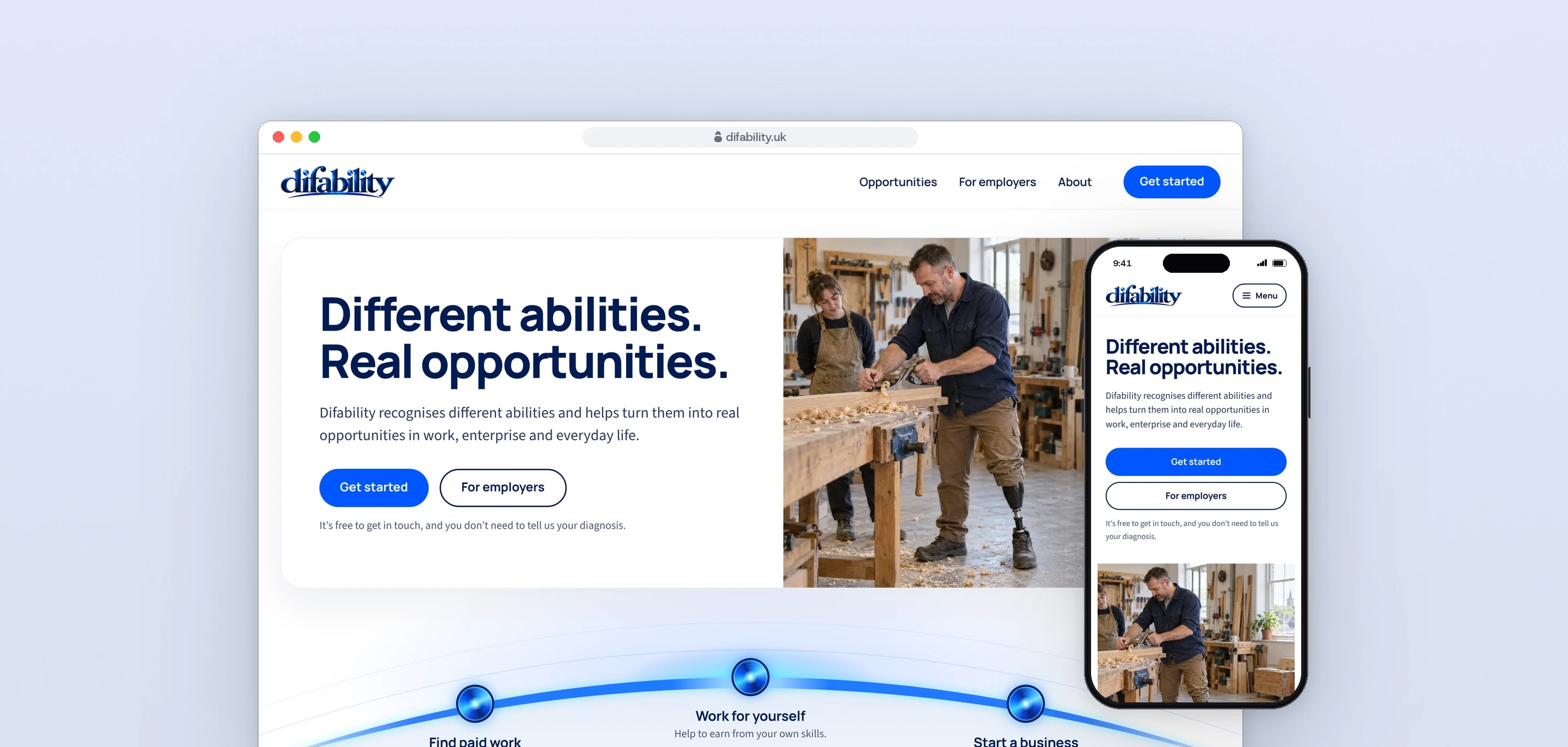
Difability recognises different abilities and helps turn them into real opportunities in work, enterprise and everyday life. We designed and built difability.uk for disabled people, veterans, carers and the employers who work with them.
- Client
- Difability
- Sector
- Social enterprise
- Year
- 2026
- Platforms
- Website, Mobile web
- Services
- Product and UX design, Web development
Difability is an initiative of IT’S POSSIBLE NOW Community Interest Company. Its website sets out three routes, finding paid work, working for yourself and starting a business, explains how working affects benefits, gives employers a page of their own, and leads every path to one short enquiry form.
Built for
- Disabled people and people with long-term health conditions.
- Armed forces veterans and unpaid carers.
- Employers and businesses who want to hire, adapt their workplace, offer discounts or be recognised.
The problem
Someone deciding whether to get in touch has two questions before anything else: will they ask about my health, and what happens to my benefits if I work. The DWP’s own work aspirations survey found fear of losing benefits to be the biggest stated brake on disabled people who want to work.
Difability sits in the same group as ipncic.com. It needed its own voice and brand, while both sites describe how the two relate in the same words.
The pages needed pictures of people at work, and no pictured person could be presented as a participant, a customer or a result.
Goals
- 01Answer the health question before the form: nobody needs to share a diagnosis.
- 02Explain working and benefits as GOV.UK states it, and point people to an adviser for their own case.
- 03Give employers a route of their own on the same site.
- 04Describe Difability and IT’S POSSIBLE NOW the same way on both sites.
- 05Pass automated accessibility checks on every page at phone, desktop and 320px widths.
Our role
We designed and built the site, deployed it next to ipncic.com on the same server, and test it with scripted user journeys.
What we delivered
- Seven pages: home, opportunities, employers, about, get started, privacy and accessibility
- Audience research from GOV.UK, DWP and charity sources
- Content design, including working and benefits guidance written from GOV.UK
- Get started form, the team’s email and the visitor’s confirmation email
- Briefs for the illustrative pictures, and the captions that label them
- Playwright and axe journey checks at three screen widths
- CI/CD to a Linux server with release switching and rollback
How we worked
- 01
Answer the two questions first
The first screen says that getting in touch is free and needs no diagnosis. The opportunities page has a section on working and your benefits, reachable from its first screen.
- 02
Say the relationship once
Both sites use the same three lines in the same order: IT’S POSSIBLE NOW creates and tests routes to opportunity, SHAPE finds barriers and tests the changes that remove them, and Difability turns what has been tested into recognised practice.
- 03
Picture the route, never claim the person
Each route carries a generated picture of someone at work, captioned as an example of that route. No caption or alt text describes a pictured person as a participant, a customer or an outcome.
- 04
Test the journeys as well as the build
Scripted journeys open every page at three widths, run axe on each one and send the form end to end with throwaway identities. Against the live site the two real sends are skipped, so the company inbox receives no test mail.
Screens and features
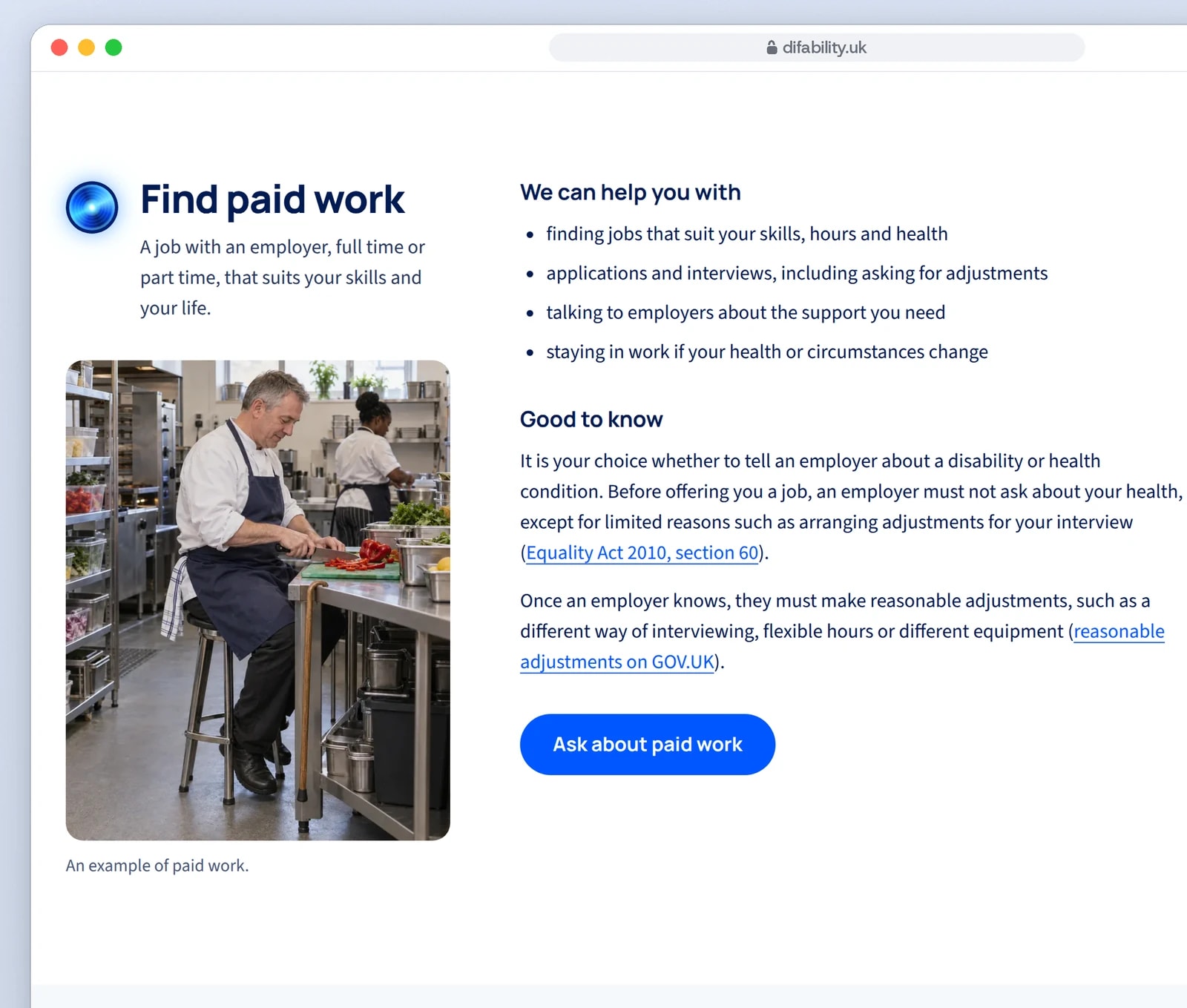
Each route explains the support that exists
Plain sentences that say what support exists, written for the people the site serves.
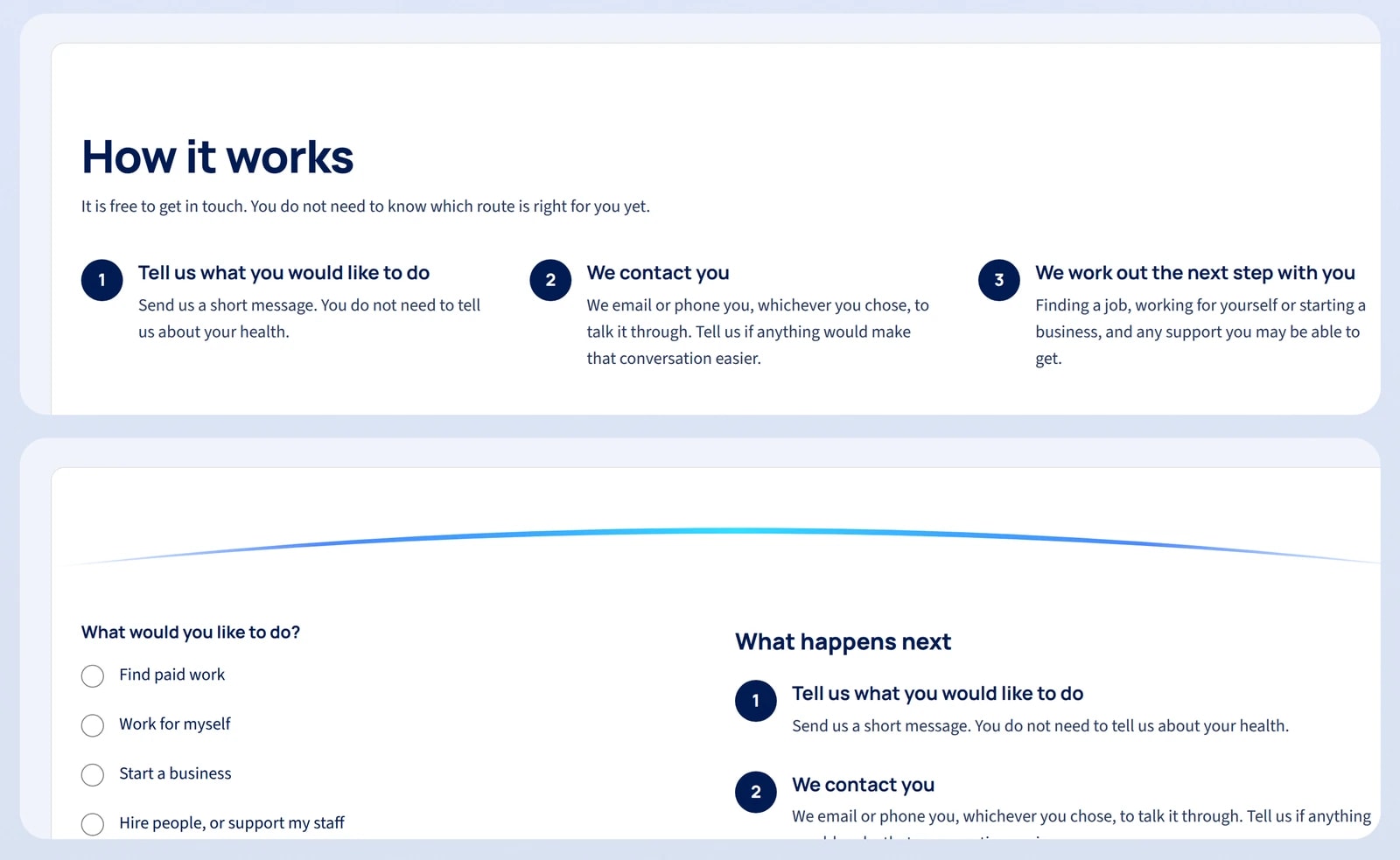
What happens after getting in touch
Three plain steps, and a form that says what happens next.
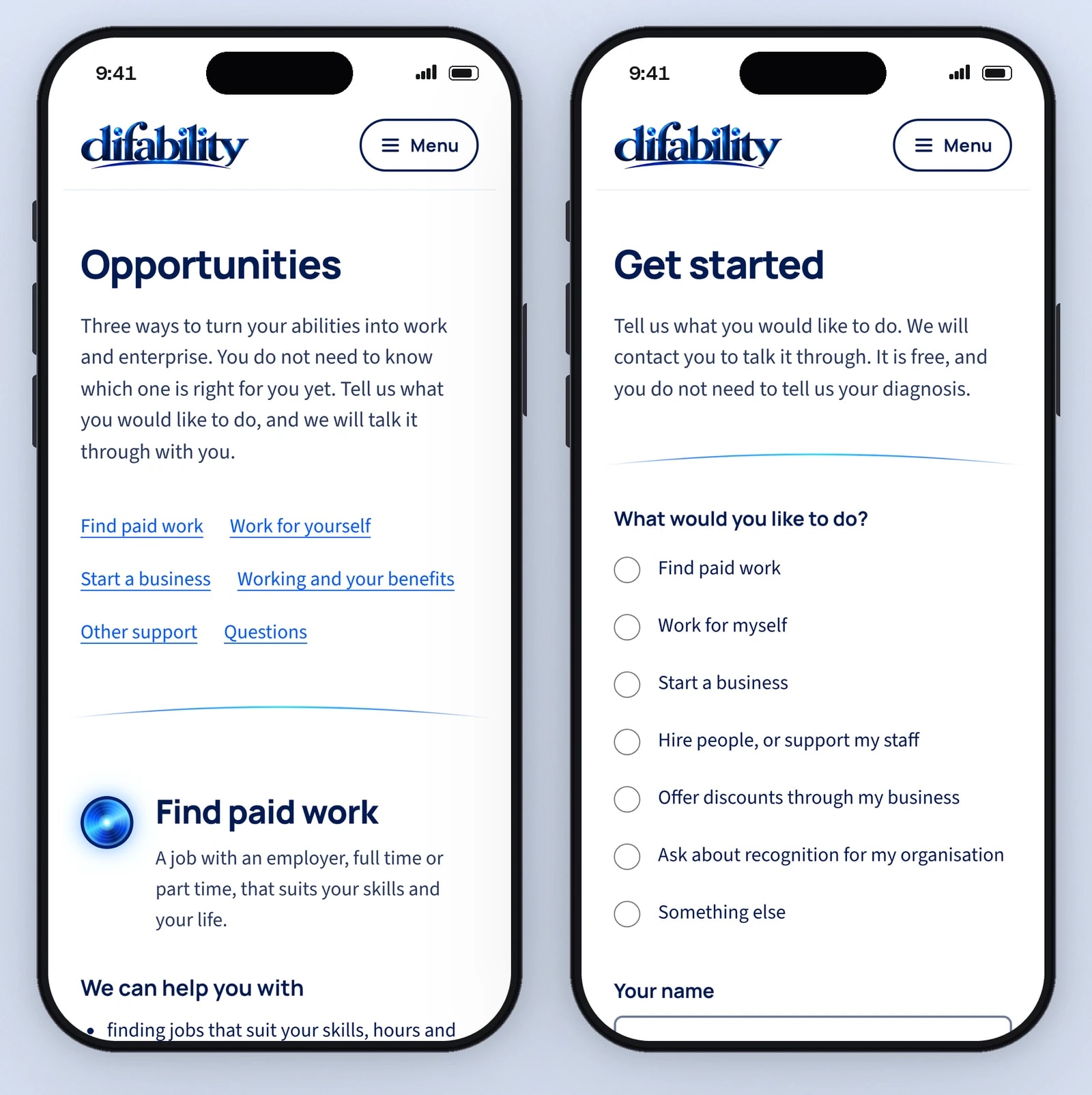
Every route works on a phone
The routes and the enquiry form read in one column, with the next step always in reach.


No question about health
The home page, the form and the next steps each say that nobody needs to share a diagnosis, and the form has no field for one.
Working and benefits, from GOV.UK
PIP, Universal Credit, ESA, Carer’s Allowance and Access to Work, with notes for veterans, carers and Northern Ireland, each stated the way GOV.UK states it and ending with where to get advice.
One form for people and employers
Seven answers to one opening question cover finding work, working for yourself, starting a business, hiring, offering discounts and recognition. Buttons on the route and employer pages open the form with the right answer already chosen.
Every error at once
The server returns all the errors together. The summary lists them in page order and links each one to its field.
A confirmation for the visitor
Anyone who chooses to be contacted by email gets one confirmation from Difability. The team’s email ends in one button: reply by email, or call the number given, whichever the visitor chose.
Checked down to 320px
Every page is tested for sideways scrolling at 320px wide, as well as at phone and desktop sizes.
Technical choices
What the product is built with, and why.
- Next.js 16 with no database
- Seven pages and one form. Pages are prerendered and a server action handles each enquiry, so no database holds anyone’s details.
- Playwright with axe-core
- The journey script drives a real browser through every page and the form, fails on any axe violation, console error or sideways scroll, and lists every failure from one run.
- The release pipeline from ipncic.com
- Both sites run on one server, each as its own service on its own port. GitHub Actions unpacks each build into a timestamped release, switches to it, smoke-tests the live site and switches back if the test fails.
- A build check for em dashes
- The site’s style has no em dashes. A script scans every tracked file and fails the build if one appears, so the rule holds without anyone having to remember it.
Building a site for people with access needs?
We design pages and forms that answer the hard questions early. Tell us who you need to reach.