AphroditeCampus introductions where mutual interest ends in a booked date
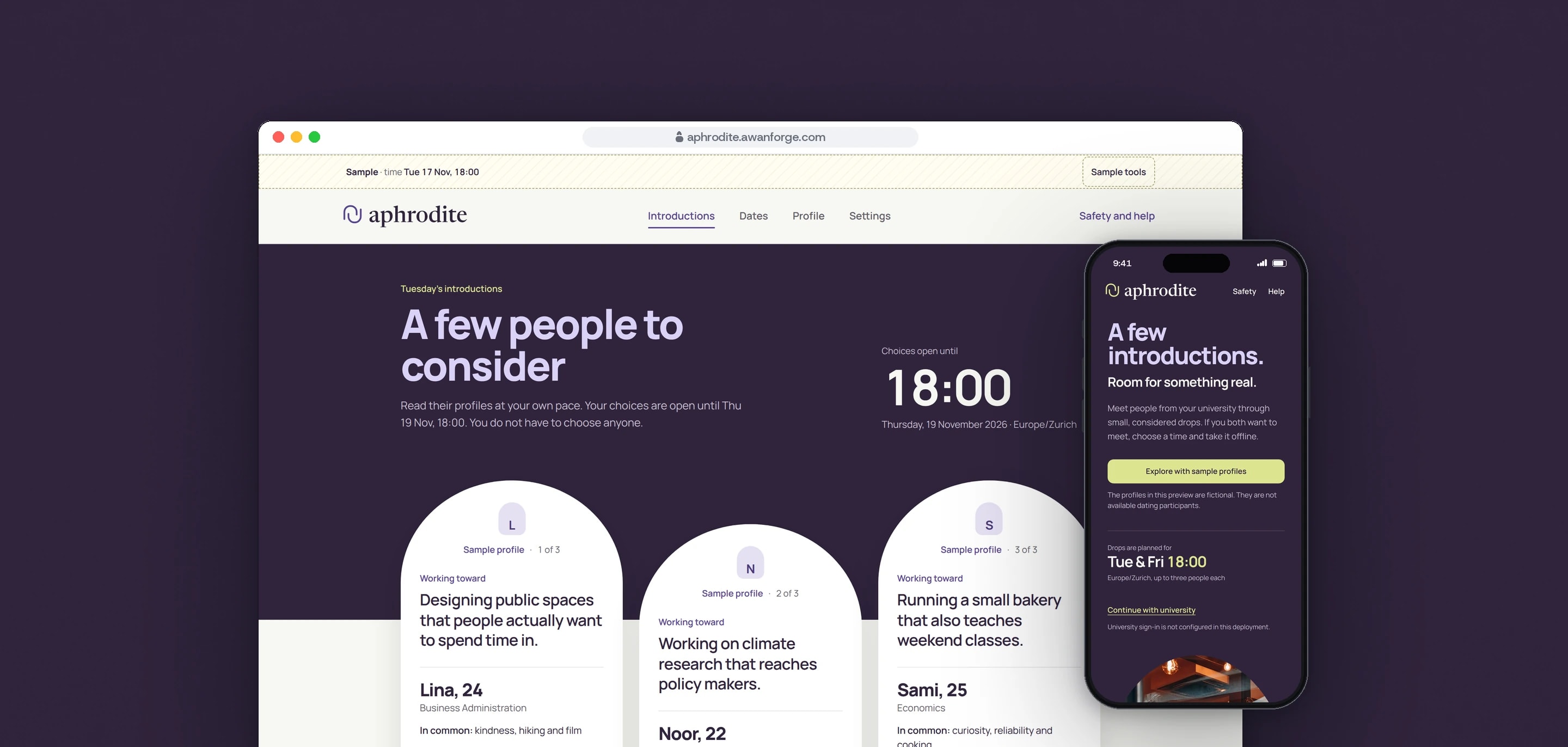
Aphrodite introduces students at one university to a few people at a time, twice a week. When two people both say Interested, they get three real times and places, and the earliest time both choose becomes the date.
A self-initiated portfolio build, designed and built by Awan Forge. The live sample gives each visitor their own sandbox with fictional adult members and a sample clock.
Your own sandbox with sample profiles. No sign-in.
- Type
- Self-initiated portfolio build
- Platforms
- Web app, desktop and phone, light and dark
- Our work
- Product rules, design direction, interface, API and database, testing, hosting
- Built with
- ASP.NET Core on .NET 10, PostgreSQL, Next.js 16, React 19, Radix, Motion
- Date
- November 2026
An introductions service is its rules
When introductions appear, who learns what and when, how a plan is made, and what happens when someone cancels or leaves: people judge a service like this on those rules. Each one has to hold on the server under retries and races, and read plainly on a phone.
What Aphrodite has to do
- Introduce a few people at a time, at a time everyone knows.
- Keep interest private until it is mutual.
- Turn a mutual match straight into three real times and places.
- Confirm that both people came, without tracking anyone.
- State the cancellation, safety and deletion rules plainly, and hold them on the server.
Built for
- Students
- Adults at one university, who get up to three introductions per drop and choose at their own pace.
- The campus team
- Its operators preview and publish each drop by hand and look after venues and their time slots.
- Moderators
- They review reports and appeals; an appeal is decided by a different moderator.
From a drop to a date, in one run
The sample run captured for this page, on the sample clock in Europe/Zurich. Times are the product's headline type: they lead every screen, with the full date and time zone under them.
Tue 17 Nov18:00
Tuesday's drop
Once you publish your profile, the sample operator publishes the first drop for you: Lina, Noor and Sami. Choices stay open until Thursday 18:00.
Tue 17 Nov18:03
Mutual
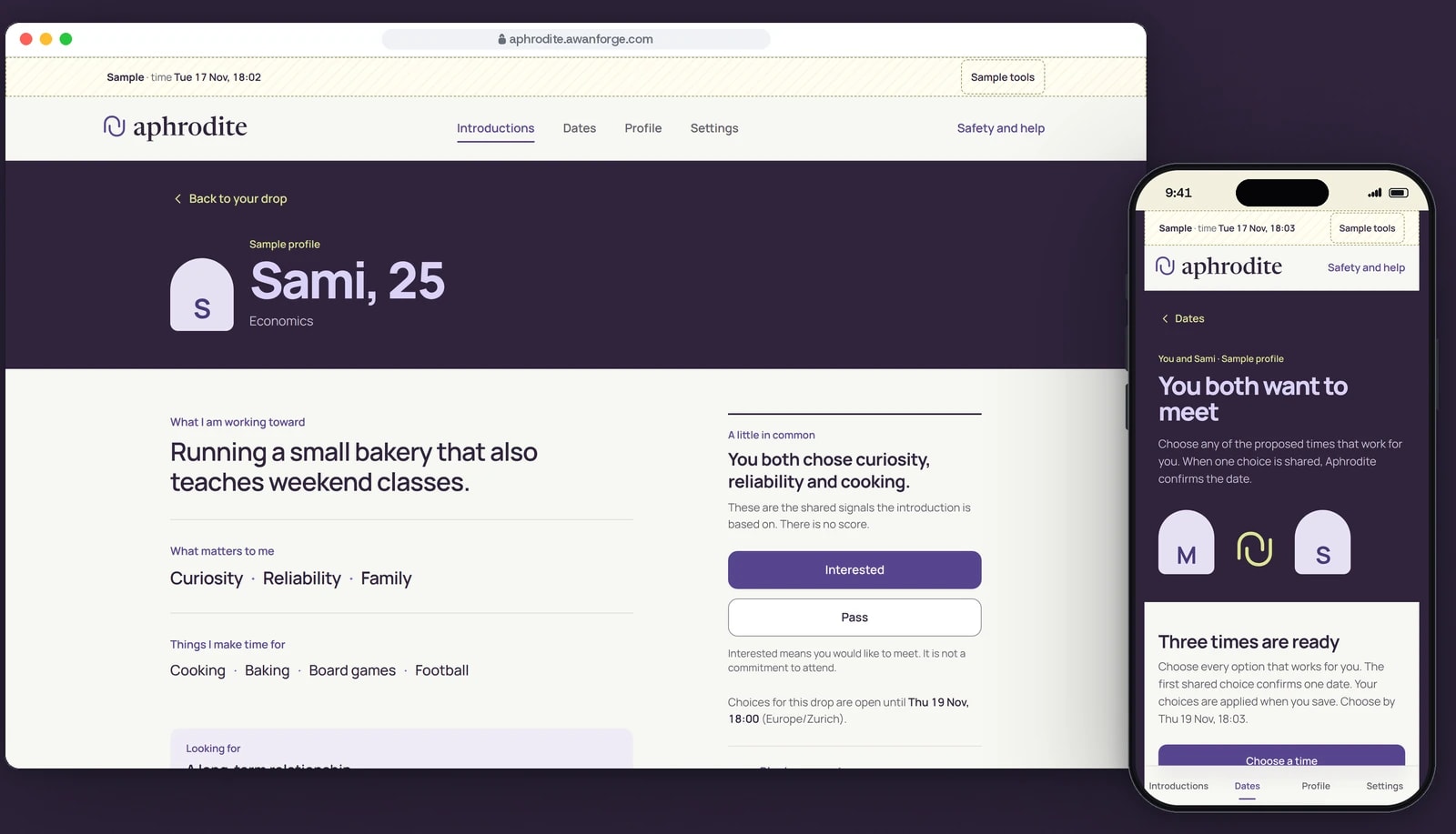
You say Interested in Sami, whose sample profile had already said Interested. Neither saw the other's choice until both had made one.
Tue 17 Nov18:03
Three times
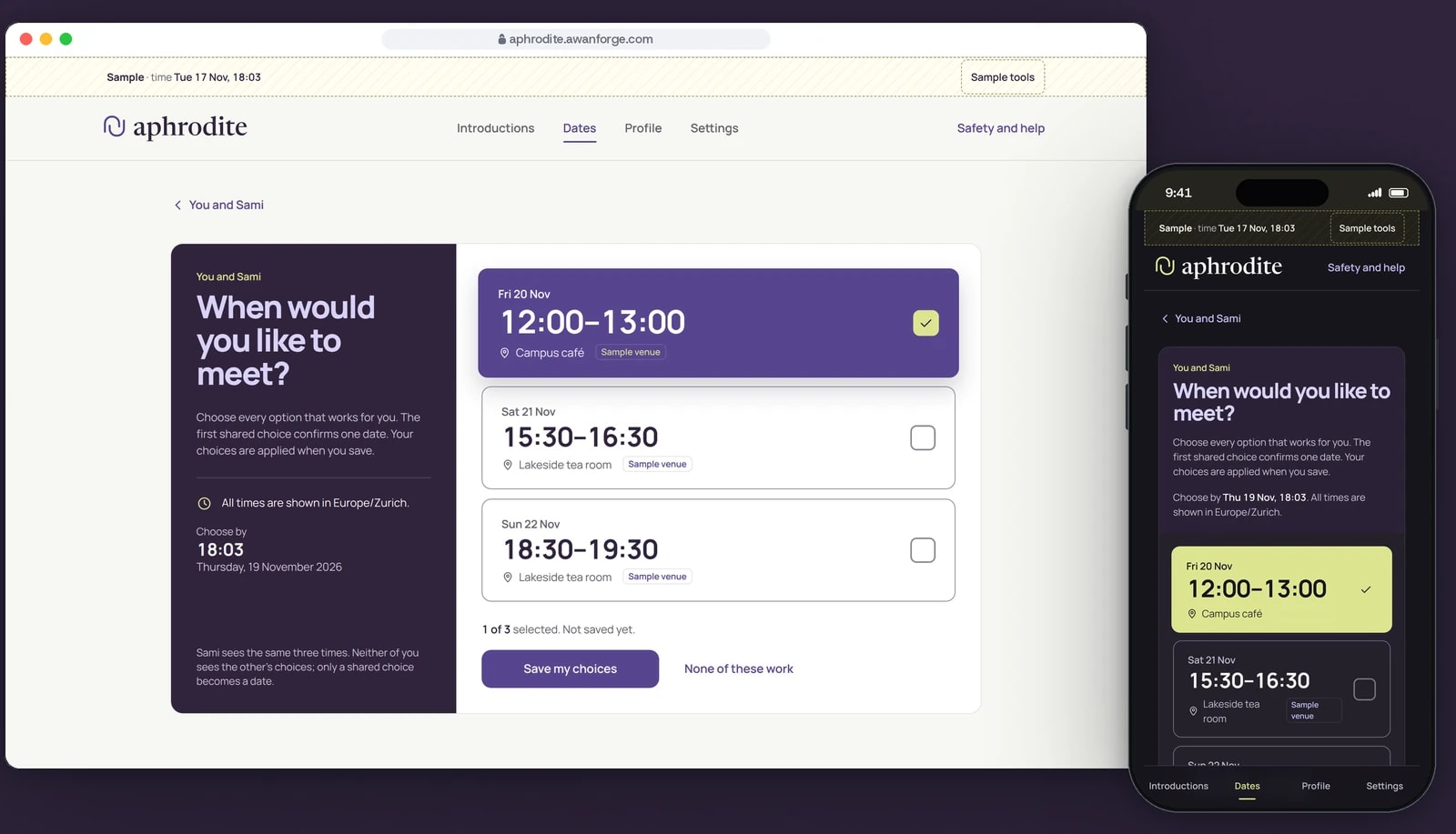
Friday 12:00 at Campus café, Saturday 15:30 and Sunday 18:30 at Lakeside tea room, to choose by Thursday 18:03.
Tue 17 Nov18:04
Booked
Two times saved. Saturday 15:30 was the earliest time both had chosen, so it became the date.
Sat 21 Nov15:30
Check-in opens
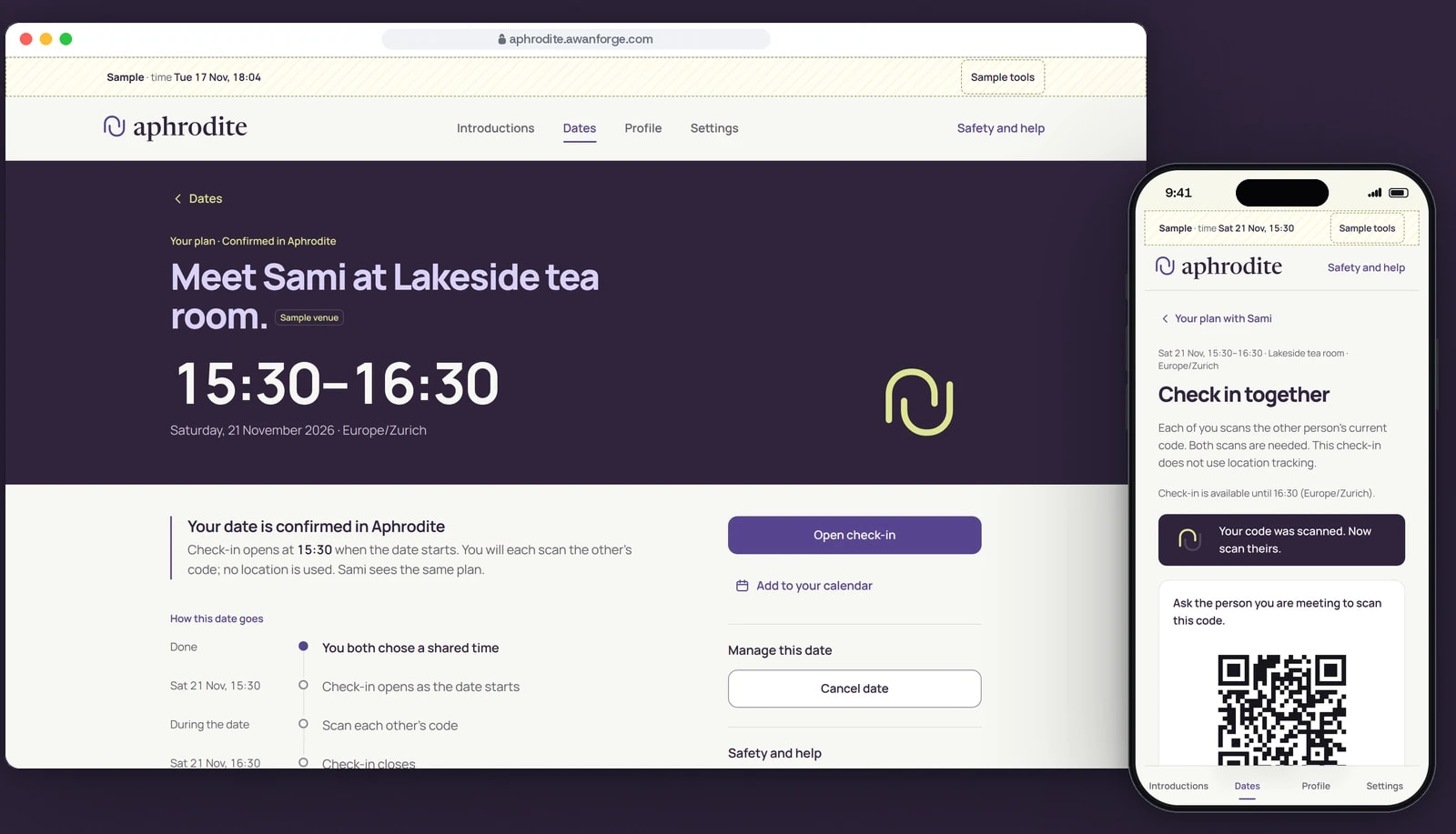
The sample clock moves to the date. Each phone shows a code that changes every minute, and each person scans or types the other's.
Sat 21 Nov15:31
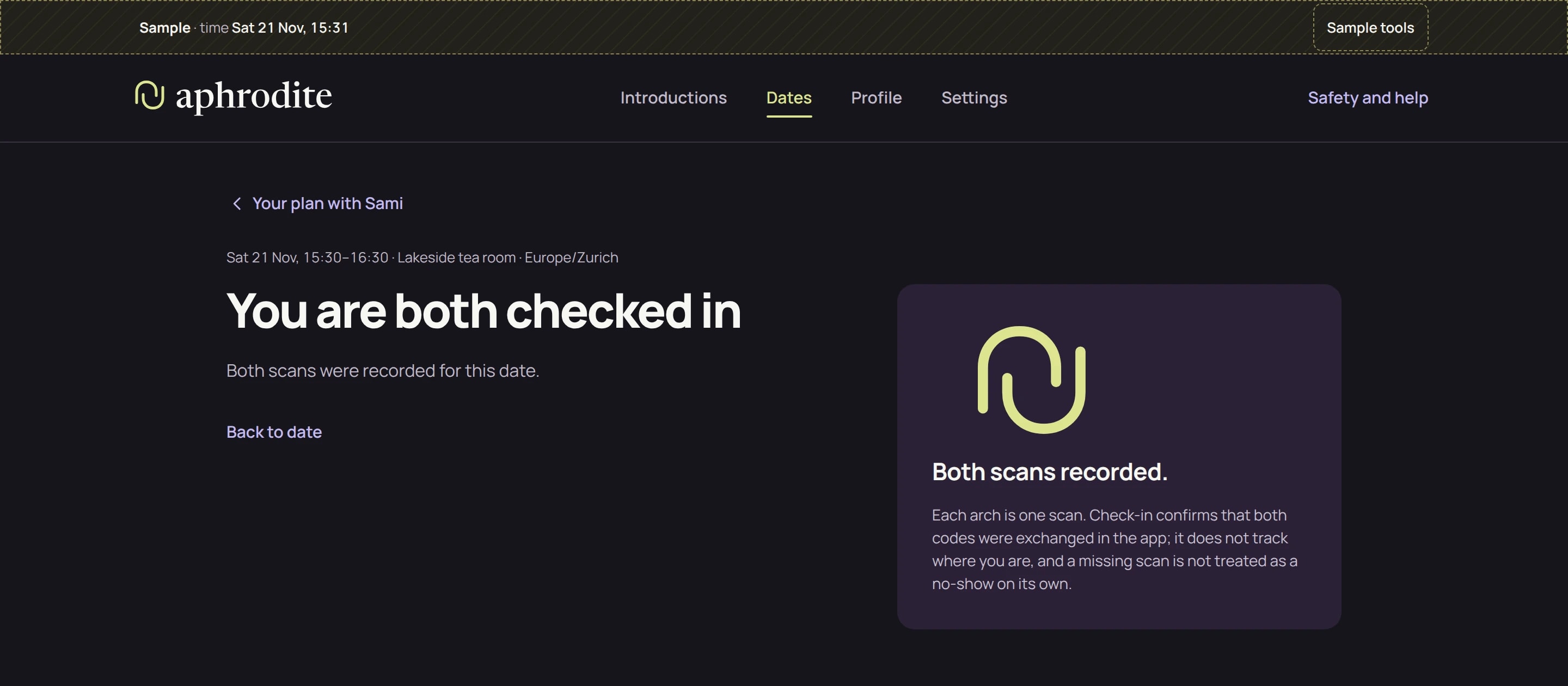
Both checked in
Both arches of the mark fill. Nothing asked where either person was.
Six rules the server holds
The browser only shows what the server allows. Each rule below is enforced in the API and the database, and each has an integration test that runs against a real PostgreSQL database.
Drops are published by hand
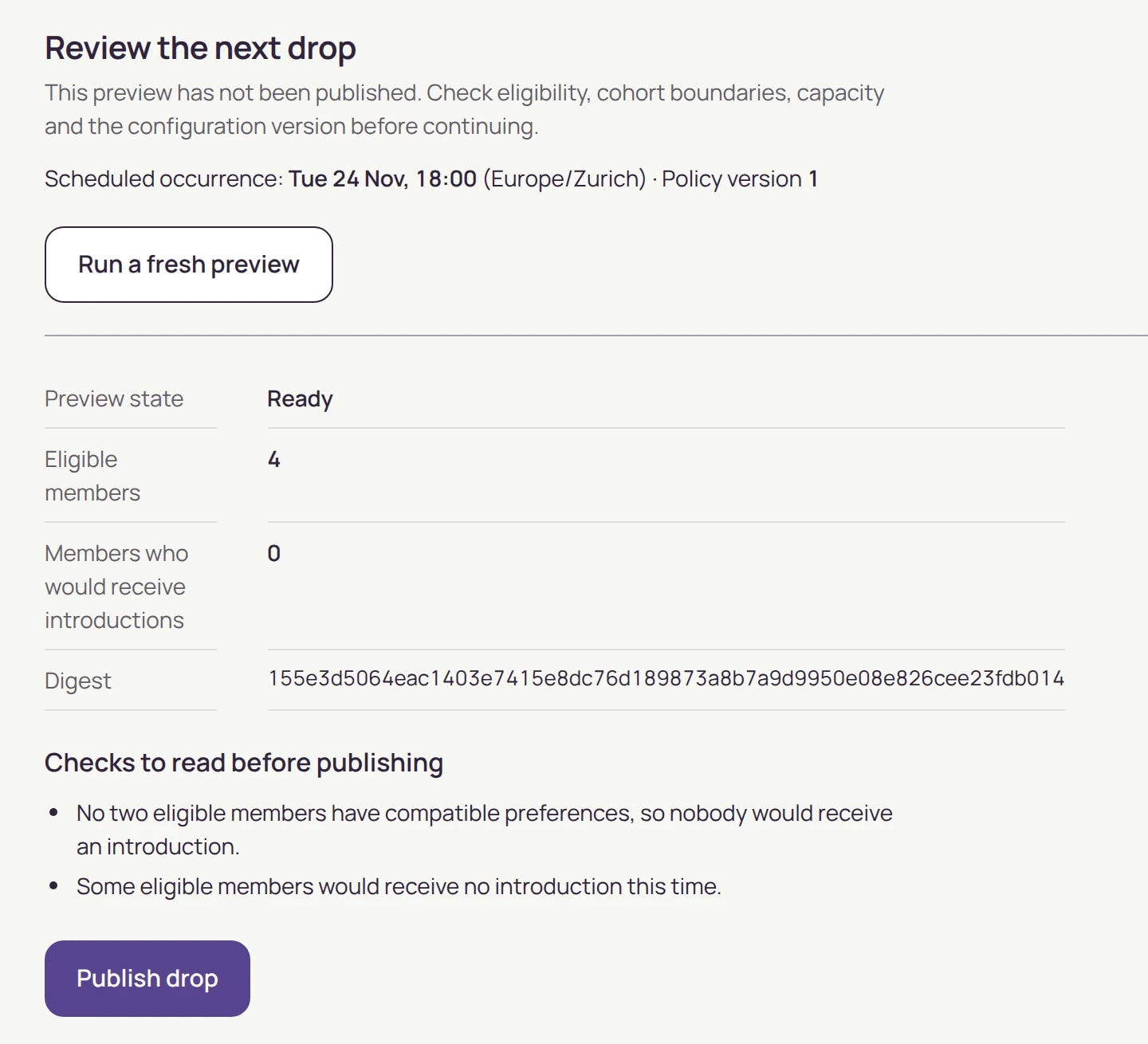
An operator from the campus team previews the next drop, reads its checks and publishes it, at Tuesday or Friday 18:00. The planned time is a plan, never an automatic trigger. In the sample, the first drop is published for you when you publish your profile.
TestedEight parallel publications and a retried request produce one drop and one set of introductions.
Interest stays private until it is mutual
Saying Interested or Pass changes nothing the other person can see. Members see shared signals and no compatibility score.
TestedThe other person's view is byte-for-byte identical before and after; interest sent at the same moment creates one proposal.
The earliest shared time books the date
A match gets three real times at venues with places left. Each person picks every time that works, neither sees the other's picks, and the earliest time both chose becomes the date.
Tested100 parallel submissions make one booking. Four matches racing for a venue's last place make one booking, and the other three are told that new times are needed.
Check-in is an exchange of codes
During the date each phone shows a code that changes every minute, and each person scans or types the other's. Nothing asks where anyone is.
TestedExpired, altered, replaced and self-scanned codes are refused; a retried scan is recorded once.
Six hours is the cancellation line
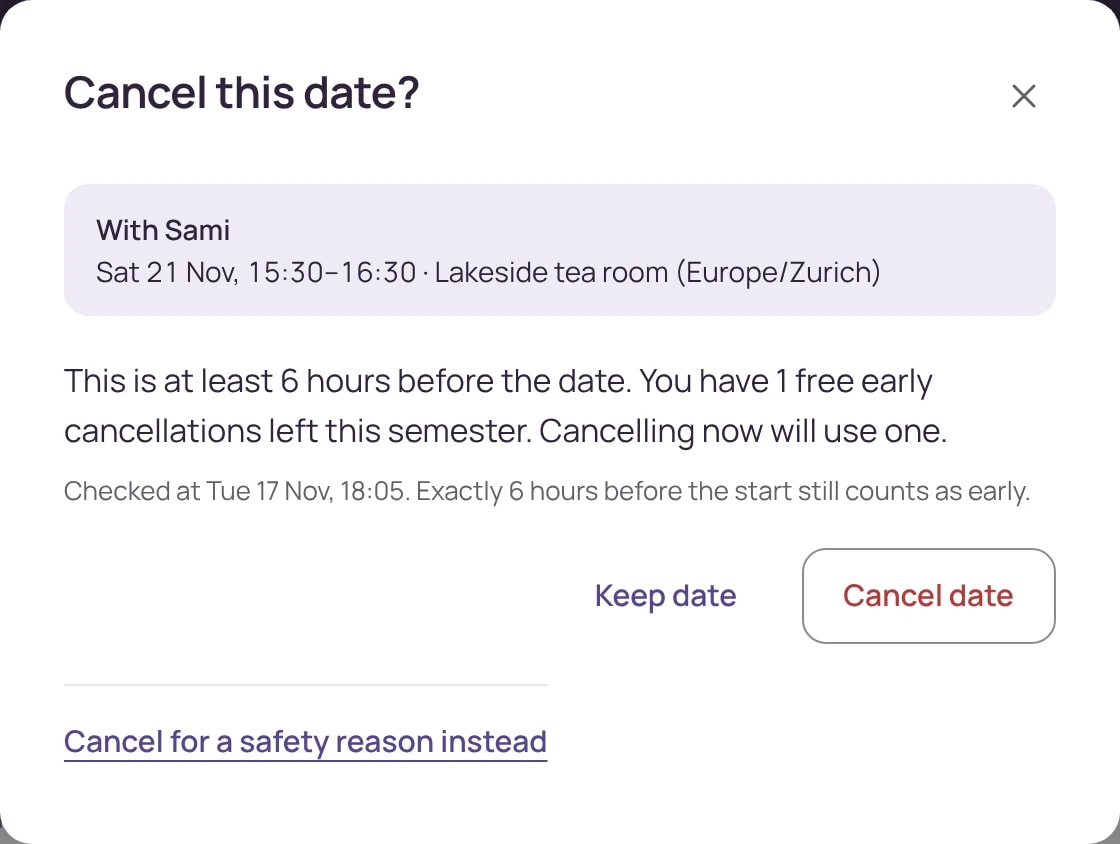
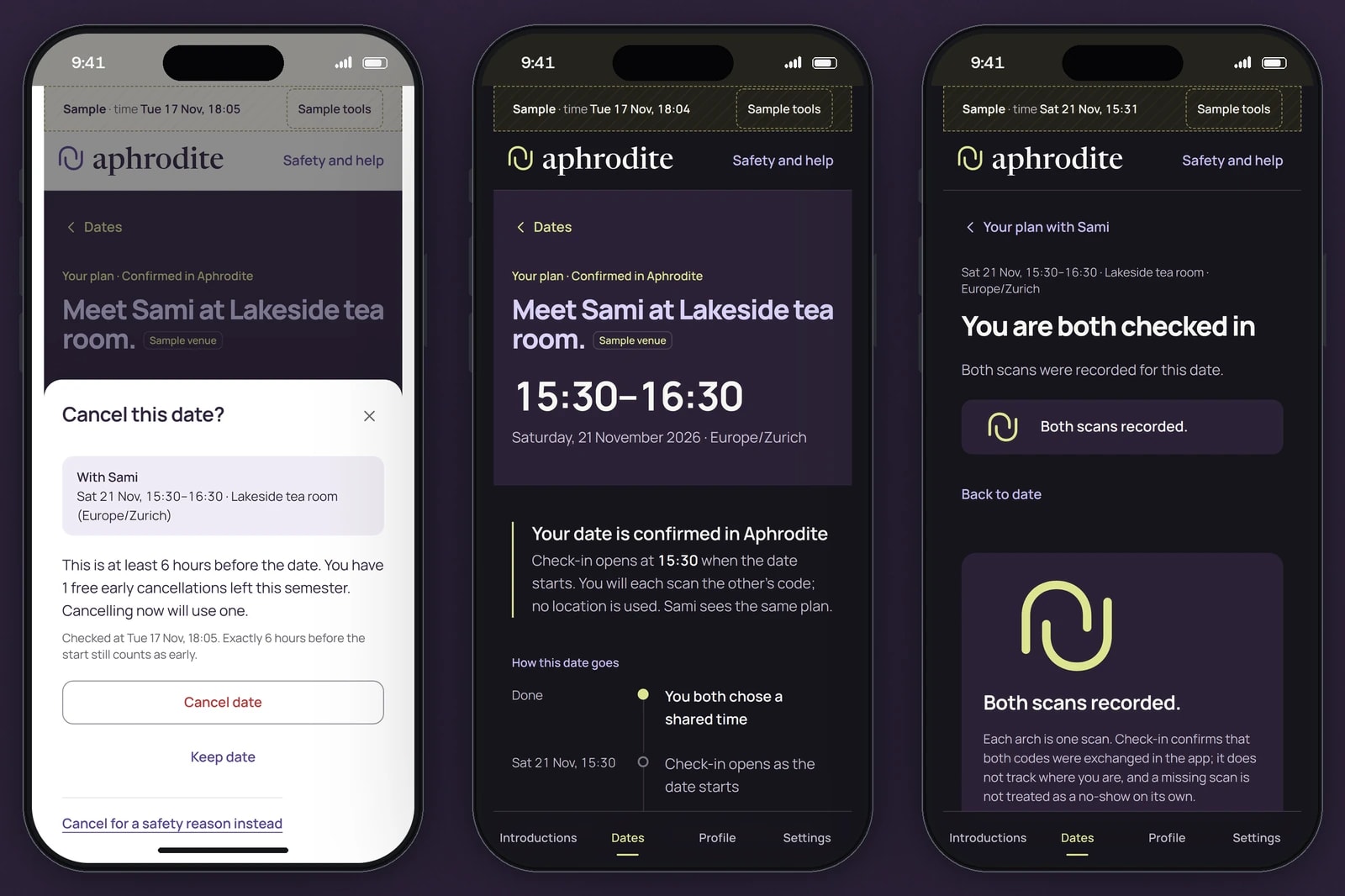
Six hours or more before the start is early: two free each semester, then a seven-day pause on new matches. Later is late: seven days, then fourteen. A safety cancellation never counts.
TestedExactly six hours counts as early and one second less counts as late.
Deleted stays deleted
Deleting an account ends its session at once, cancels any date neutrally and erases its rows. A backup restored later cannot bring the person back.
TestedA real database dump taken before a deletion was restored. The API refused every request until the deletion ledger was replayed, and afterwards the person, their booking and sessions were gone.
Live sample
Live sample
An arch, a clock and colour fields
The look comes from the product's subject: two people, a few introductions, one real plan. The logo's two open arches stand for two people meeting, so the same arch frames each introduction, shows two people apart while they wait and together once it is mutual, and fills one side per scan at check-in. Times are set as large tabular numerals with the full date and time zone under them.
Before drawing a screen we studied three products and wrote down what to take and what to change. None of their copy, images or claims is used.
| Reference | What we took | What we changed |
|---|---|---|
| A dating app's marketing sitePrimary | Deep colour fields that carry large type, and a time of day used as a headline. | Aubergine and pale iris fields, and the drop time set as the largest thing on the screen. |
| A scheduling tool's booking pageSupporting | A fixed context column, one solid selected time, tabular numerals and a visible time zone. | The planner: who and how on the left, three times on the right, the chosen one in deep iris with a citron tick. |
| A dating app's product materialSupporting | A profile read as small prompts with large answers. | Signals before photographs: what someone is working toward leads, and members show an initial in an arch-topped tile. |
Colour
- Aubergine#30243CColour fields, headers and text
- Mineral#F7F7F2The page, and text on dark fields
- Deep iris#58458FActions, links and the selected time
- Citron#DDE590Small markers: ticks, the current tab, a filled arch
Type and themes
- Manrope, the only typeface
- Titles get their character from weight 800, tight tracking and large tabular numerals for times.
- Light and dark, each designed
- The dark theme has its own night field and citron actions, chosen from the system setting until the member picks one.
- No photographs of people
- Members appear as an initial in an arch-topped tile. The welcome page uses one photograph of a café, credited on the site.
Live sample
Desktop and phone, light and dark
On a phone Aphrodite shows one task at a time: one introduction per screen with Previous and Next, a bottom bar with text labels, and dialogs that open as sheets. On a wide screen the same pages gain a context column beside the content. Controls are 48 px high. Every state was reviewed in both themes at 1440 and 390 px, and the main screens in light at 1920, 1024, 768 and 360 px.
Every screen below is a capture of the live sample taken on 18 November 2026.
Interest stays private until it is mutual
A profile shows shared signals and no score. Nobody learns about an Interested or a Pass until both people say Interested.
Three real times, and the earliest shared one books
Each match gets three times at venues. Neither person sees the other's choices, and the earliest time both chose becomes the date.
A dated plan, and check-in by swapping codes
At the date each person scans or types the other's code. One arch of the mark fills per scan, and no location is used.
The date on a phone, from plan to check-in
Cancelling says if the date is at least six hours away and how many free early cancellations are left. Then the plan and check-in, in the dark theme.


How it is built, and what was run
Results from runs on 18 November 2026 against local servers. Nothing here is a measurement of real users.
- ASP.NET Core on .NET 10: one API as a modular monolith, with modules for identity, profiles, matching, dates, policy, privacy and administration.
- PostgreSQL with hand-written SQL and embedded migrations. Constraints back the rules: one live pair per couple, and an exclusion constraint that stops one member holding two overlapping dates.
- A transactional outbox worker for notices, sandbox expiry and erasure. Birth dates, private preferences and case text are encrypted at field level.
- Next.js App Router, React 19, Radix dialogs that open as sheets on phones, and Motion for state changes only. Reduced motion removes the travel.
| Check | Result |
|---|---|
| Server tests on a real PostgreSQL database, a fresh one per run | 97 passed, 0 failed |
| Responses checked against the OpenAPI contract | 59 of 59 conform |
| Mutation check: the six-hour boundary made exclusive and a capacity check removed | 4 tests failed, as they should |
| Browser journeys in Playwright, desktop 1440 px and Pixel 7 | 13 passed, 1 skipped |
| Independent security reviews of the server and the web tier | No high or medium findings; the low ones fixed |
The skipped journey is the keyboard path, which runs on desktop only. The security findings were a stored reply that could be replayed after a block, and other spellings of /api/ that skipped the edge rate limit. No load test, multi-server run or penetration test was done.
The live sample
Aphrodite is live at aphrodite.awanforge.com. Each visitor gets a sandbox of their own: a profile to fill in, three fictional adult members whose answers overlap with theirs, sample venues in Europe/Zurich and a sample clock that can jump to the next drop or the start of a date. A hatched bar labelled Sample holds those tools, apart from the product.
The same server rules apply inside the sandbox. A sandbox cannot see another visitor's, and each address can start five an hour.
Not switched on in the sample
- Campus sign-in and age assurance
- The adapters are built and their claim rules are tested; no university identity or age provider is connected.
- Venue booking
- Venues and their slots are sample data. Nothing is reserved at a real place.
- Email and push delivery
- Notices are delivered in the app. No mail or push provider is configured.
Aphrodite is a self-initiated portfolio project with a public sample. Lina, Noor, Sami and every other member are fictional, and so are the university, venues and times. The café photograph on the welcome page is by Kader D. Kahraman on Pexels, credited on the site.
Building a product whose rules have to hold?
We design and build platforms where timing, privacy and fairness are enforced on the server and explained plainly on screen. Tell us what your product has to guarantee, and to whom.
Fictional members on a sample clock, in a sandbox of your own.